Dear friends and readers,
As you may have noticed, Earth Parade went dormant for a while, mainly because we’ve been swamped like never before since leaving Costa Rica and promptly starting our new fruit snack company. We got so busy so fast that we never got a chance to share some stories from our last couple of months searching for rare species in Costa Rica. Fortunately, we documented them at the time and journaled about them, and now, for the first time, we'll share them here. It is nice to relive these adventures from a few seasons ago. We also have some fresh adventures being planned, which we’ll update you on soon. In the meantime, please enjoy!
J+D
My father likes to tell an old doctor joke about obstetricians. You can always tell who the obstetrician is in the doctors' lounge because they are the one smoking the very long cigar. You know the joke is old not because it's not funny, but because doctors don't smoke in lounges anymore. They smoke in secret. But the point is, when it comes to the business of babies being born, sometimes you have to wait.
In a world of Google calendars, tight schedules, and always-on chatbots, I've come to understand that the best things in life happen on their own damn time.
Witnessing a new being enter this world is one of those things. I hesitate to call it a miracle, since it happens every second of every day. But as all parents will attest, at least when it comes to their own children, there is nothing mundane about a new conscious being's first moments on planet Earth.
I remember seeing the hairs of the crowns of my children’s heads first, a reminder that as special as we think we are, we are just highly evolved mammals. What followed were melodic cries, delicate heartbeats, sweet breath, and the clutch of a new palm grasping my pinky reflexively, instinctively, as if it knows its only chance to survive is to hold on. It is a moment I will never forget, when I made a solemn, silent vow to hold this hand through thick and thin.
These signs of life serve as a visceral reminder of the great mystery that preceded and exists beyond our myopic human consciousness. Fresh newborn eyes opening for the first time feel like more than just a collection of cells and nerves strewn together. That first moment of letting light in is a portal to the great mystery.
And so when presented with an opportunity to witness the birth of any creature, my MO is to act like an OB. I extinguish my daily chores like a stale cigar and zip into action to be the first witness.
And with threatened sea turtles, given my historic connection to them, I don’t just hope to coincidentally stumble upon a turtle hatching on the beach. No sir or ma’am or them, here at Earth Parade, we create these opportunities for ourselves. We knock on the doors of turtle conservancies and tell them we're here to help however we can; if there’s a nest to guard or hatchlings to escort to the sea, we are here for it.
After many weeks of trying to coordinate a turtle birth with the Reserva Playa Tortuga (Turtle Beach Reserve), showing up at all hours of the day and hoping to get lucky, we persisted enough to get the attention of Science Director Oscar Brenes, who leads a team of scientists and volunteers who intervene to protect turtle nests and hatchlings from predators and poachers. They bring the nests to a safe enclosure and monitor them. When they hatch, they bring them to the sea. Brenes connected me with a resident marine biologist, Ceci, who finally agreed to take my number and promised to call me the second they knew the turtles would hatch next.
And so we went about our business.
We surfed, played, and worked on our new fledgling fruit scroll business.
As the non-doctor in my family, I finally had the feeling of being “on call”, wondering when my life would be interrupted not to treat an illness, make a diagnosis, or deliver a baby. I wasn’t armed with a stethoscope and medical knowledge, but with my favorite tools for engaging with new experiences: a video camera and a beginner’s mind.
Finally, the call came late one afternoon, as the fiery yellow ball began its daily descent into the Big Blue Pacific. “A nest just hatched, and we are planning to release them in the next hour or so. Can you make it?”
With the verve of an OB getting an emergency call, I projected as much false confidence as possible given that the exact coordinates of my kids were currently unknown. “Yes, we’re on the way!”
“Hey D, they are releasing some baby Olive Ridleys into the wild tonight! Let’s round up the kids.
This would be the biggest obstacle in getting there on time. “Where are the kids?!” I yelled.
One was at the neighbor’s house sharpening his homemade spears for some imaginary hunt. One was 15 feet up a tree on the other side of the house. The other was nowhere to be found. We later found him sneakily looking at family photos on an iPad, hiding in the curtains.
You see, human kids are different from sea turtle babies, who emerge knowing how to crawl, swim, and find their way toward the ocean. My kids, at least, are little curious rebel babies, and I love them for it.
Humanity’s intellect and need to learn have helped us become the dominant species on the planet, but sea turtles, including the world’s most abundant species, Olive Ridleys (Lepidochelys olivacea), are in trouble.
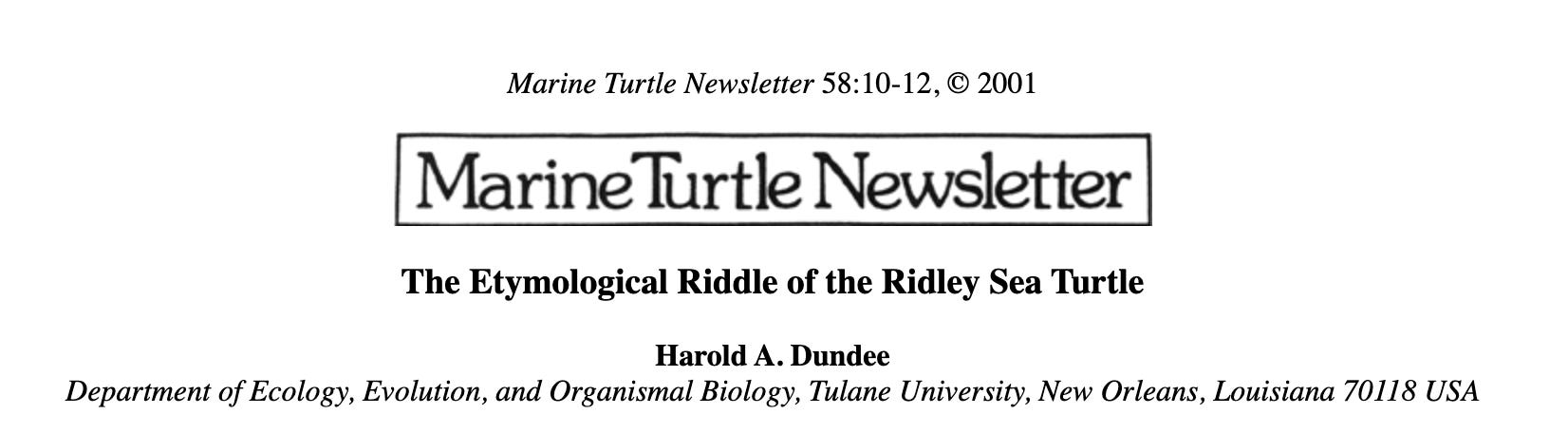
Nobody knows for sure why they’re called ridleys. The olive part comes from their olive-green shells. But “ridley,” which they share with their close relative, the Kemp’s ridley, is an etymological mystery wrapped in an enigma, tucked inside a riddle. Harold A. Dundee, an ecologist at Tulane, investigated the name and recorded one intriguing explanation. He wrote in 2001 in the now-defunct “Marine Turtle Newsletter” about Marjorie Carr, wife of turtle biologist Archie Carr, who recalled that “riddle” became “riddler” and eventually “ridley” in the fisherman twang of the Florida Keys. They thought the two tiniest sea turtle species might both be crossbreeds. The riddle was who their parents were.
What these Florida men didn’t understand is that olive ridleys aren't “bastard turtles” but the most abundant sea turtle species in the world. Today, the IUCN considers them vulnerable globally because they nest in so few places and can be decimated if those places aren't protected. This is exactly what’s been happening, especially in Asia. Although an estimated 800,000 females nest annually, nesting populations have declined rapidly in Bangladesh, Myanmar, Malaysia, and Pakistan. In Terengganu, Malaysia, the number of nests has fallen from thousands to just a few dozen per year.
Beyond natural predators like sharks, they face plenty of threats from us. They get caught in our nets, shrimp trawls, and fishing lines, and can drown. People harvest their eggs and kill adults for meat. Buildings, beach traffic, and artificial lighting disrupt nesting and hatchlings. And then, of course, there’s the plastic they consume.
Fortunately, Costa Rica legally protects olive ridleys. Ticos call them tortuga lora, and the species appears on the country’s official list of endangered or threatened marine and coastal wildlife. Costa Rican law prohibits hunting, capturing, killing, or trading sea turtles. It makes a specific exception for regulated collection of olive ridley eggs at Ostional National Wildlife Refuge, farther north along the Pacific coast.
Ostional is one of their most important nesting beaches worldwide. During an arribada (Spanish for arrival), thousands of female olive ridleys gather offshore, then come ashore in waves to lay their eggs over several days. Only members of the Asociación de Desarrollo Integral de Ostional (ADIO), the local community association, may collect eggs under the refuge’s approved management plan. They harvest early because nesting gets so crowded that later females often dig up or crush eggs laid by earlier arrivals. The program gives the community an income from some of those early eggs, alongside its work protecting the beach and turtles.
We hope to witness an arribada one day, but today’s challenge was to literally get into a car. This often feels like defying the complex physics of the sun, moon, and Earth, but somehow today we managed to round up all 3 kids in less than 5 minutes. At first they were disappointed to abandon their activities, but when we told them we were going to see newborn turtles, they were ecstatic, launching into their signature humming jingle reserved for the actual or potential sighting of cute animals, which goes something like, “Ahhe, Ahhe, Ahee, Hee He.” It’s a weird Earth Parade family thing.
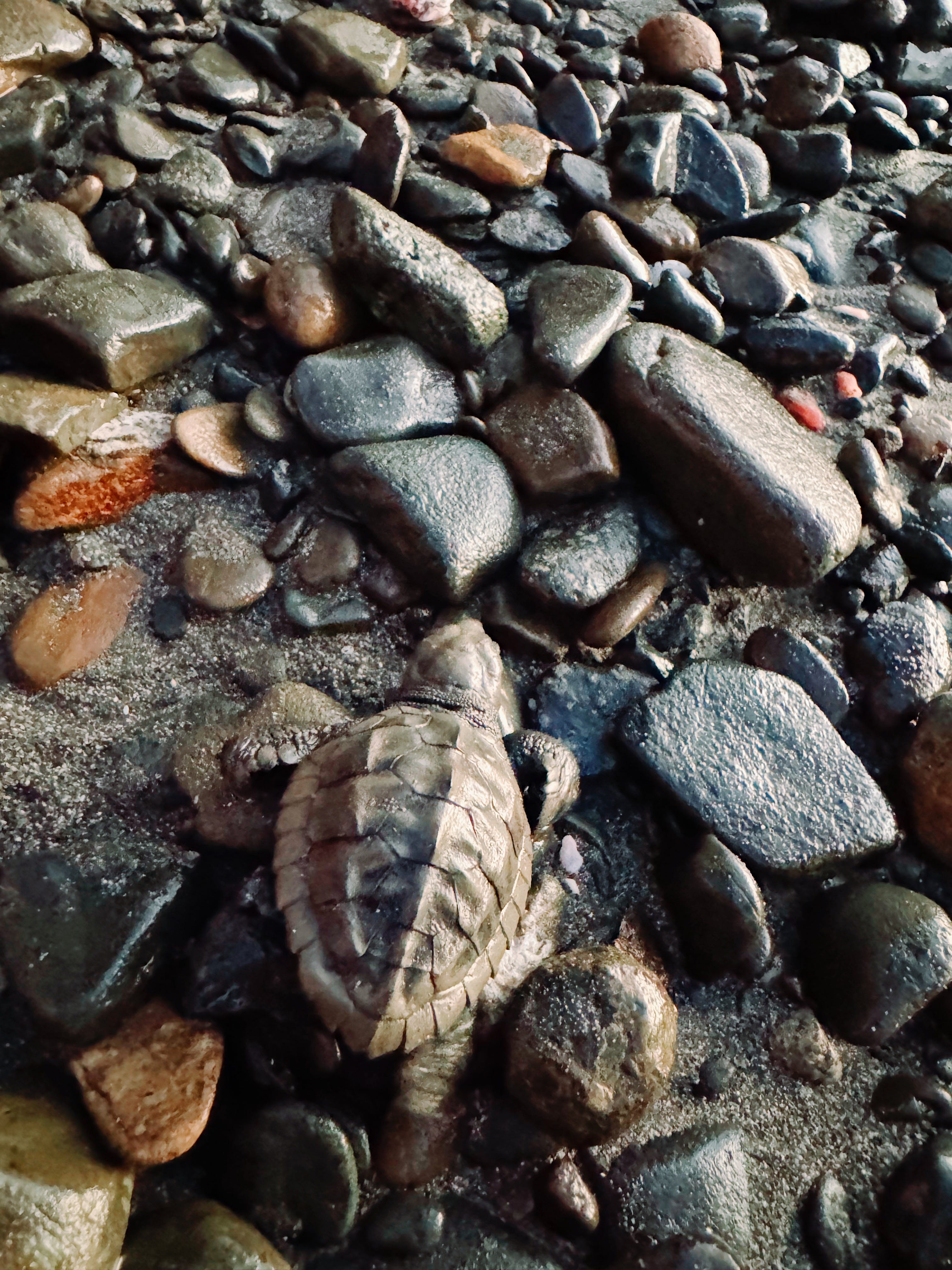
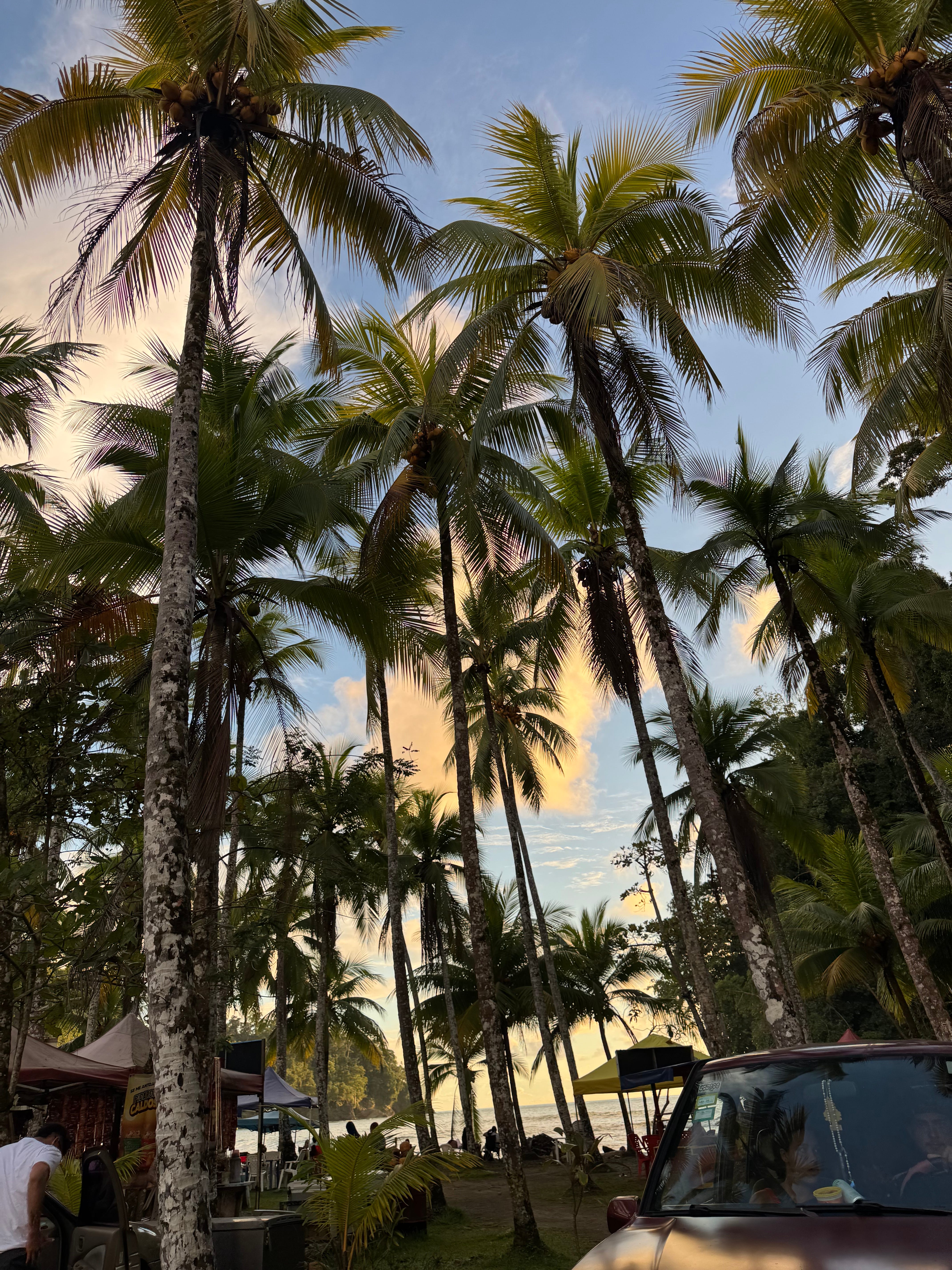
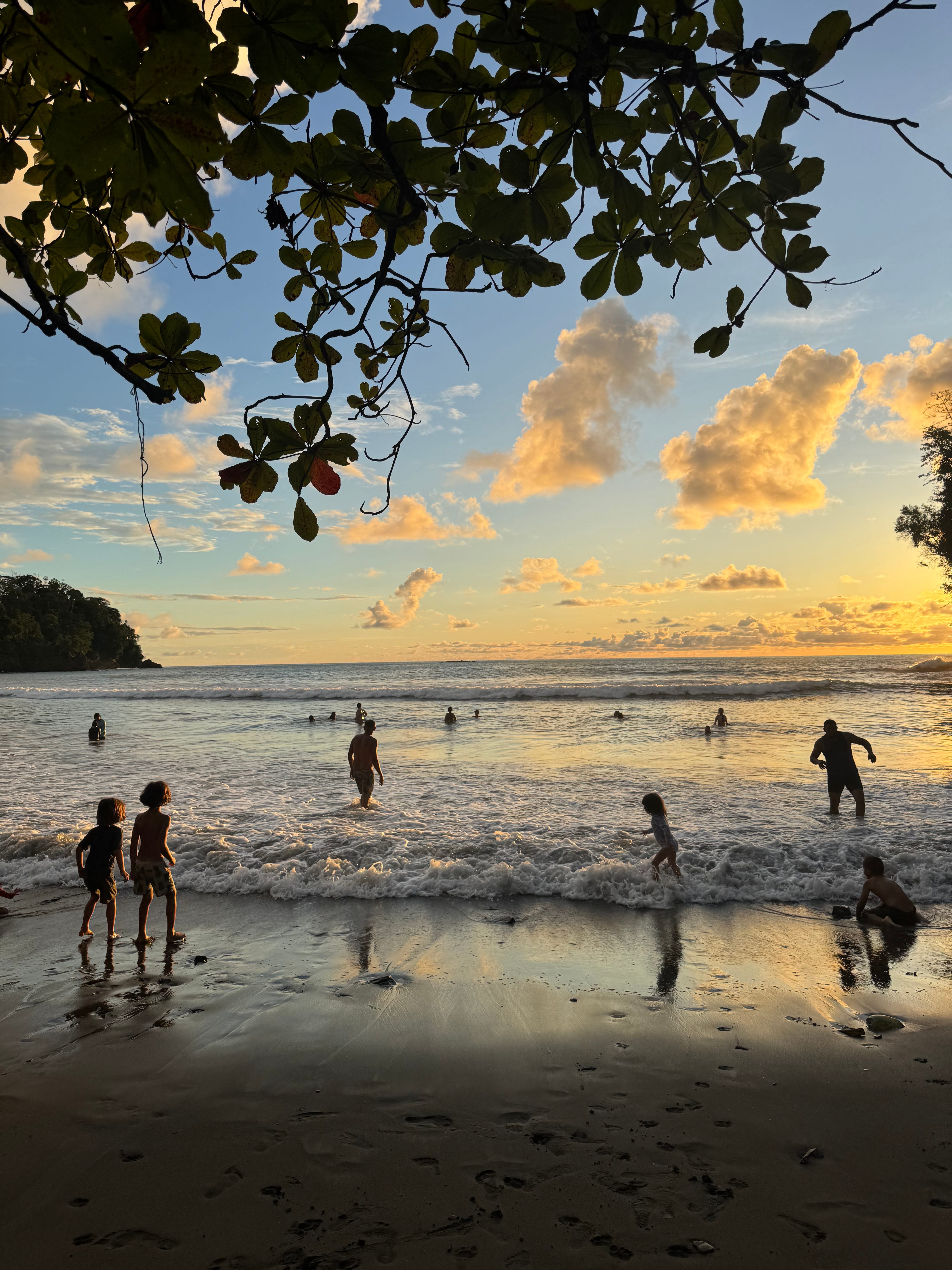
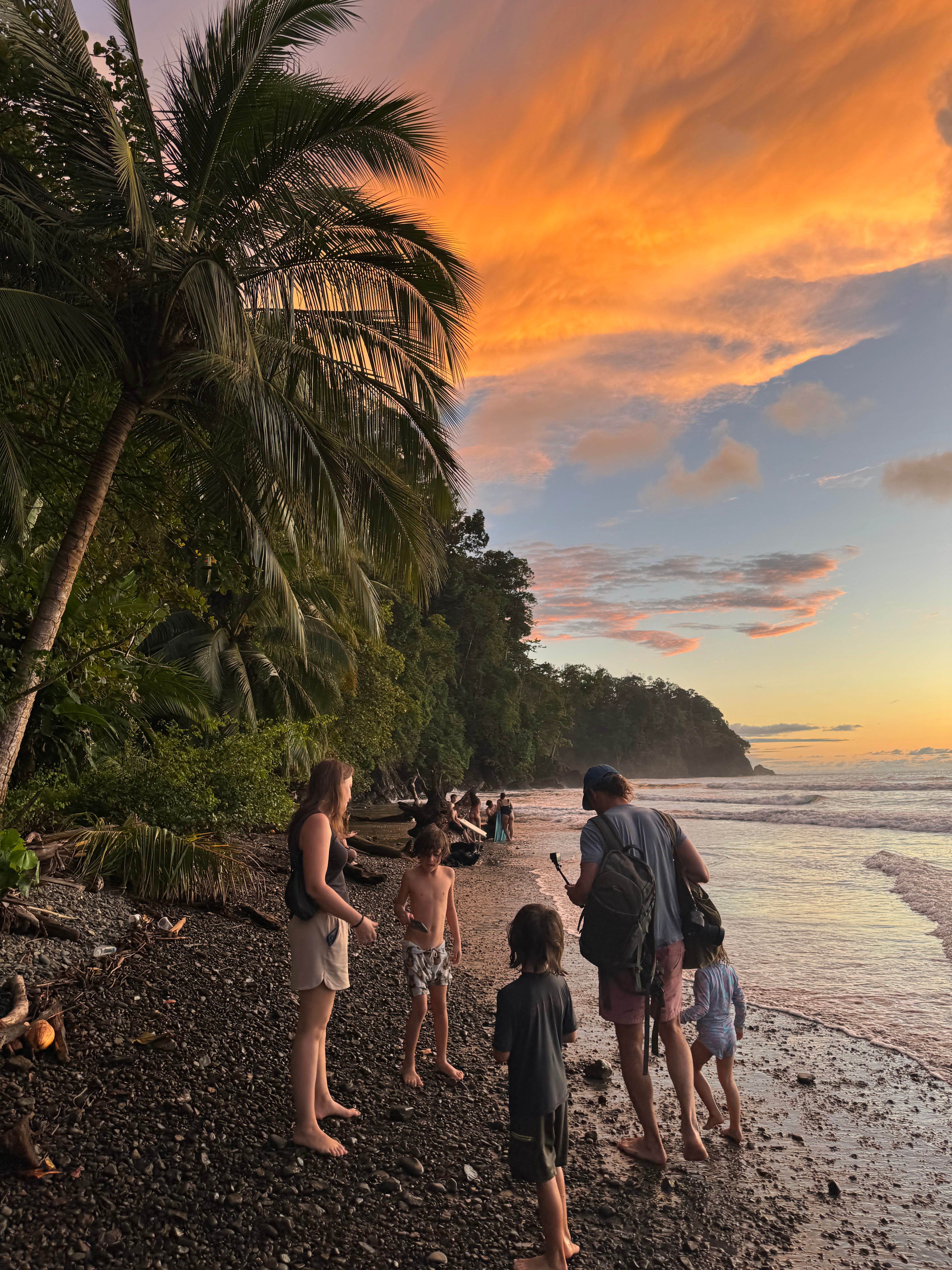
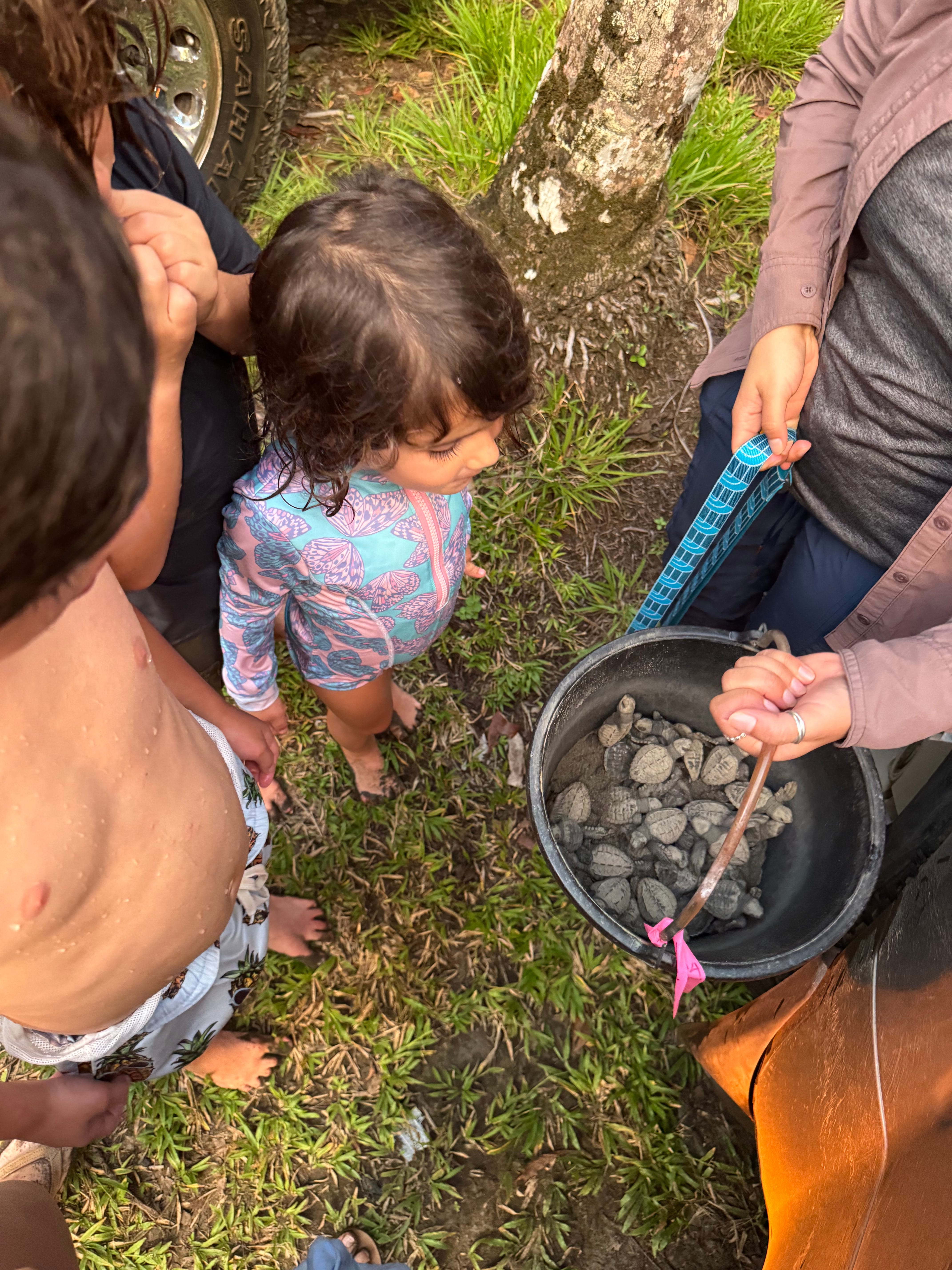
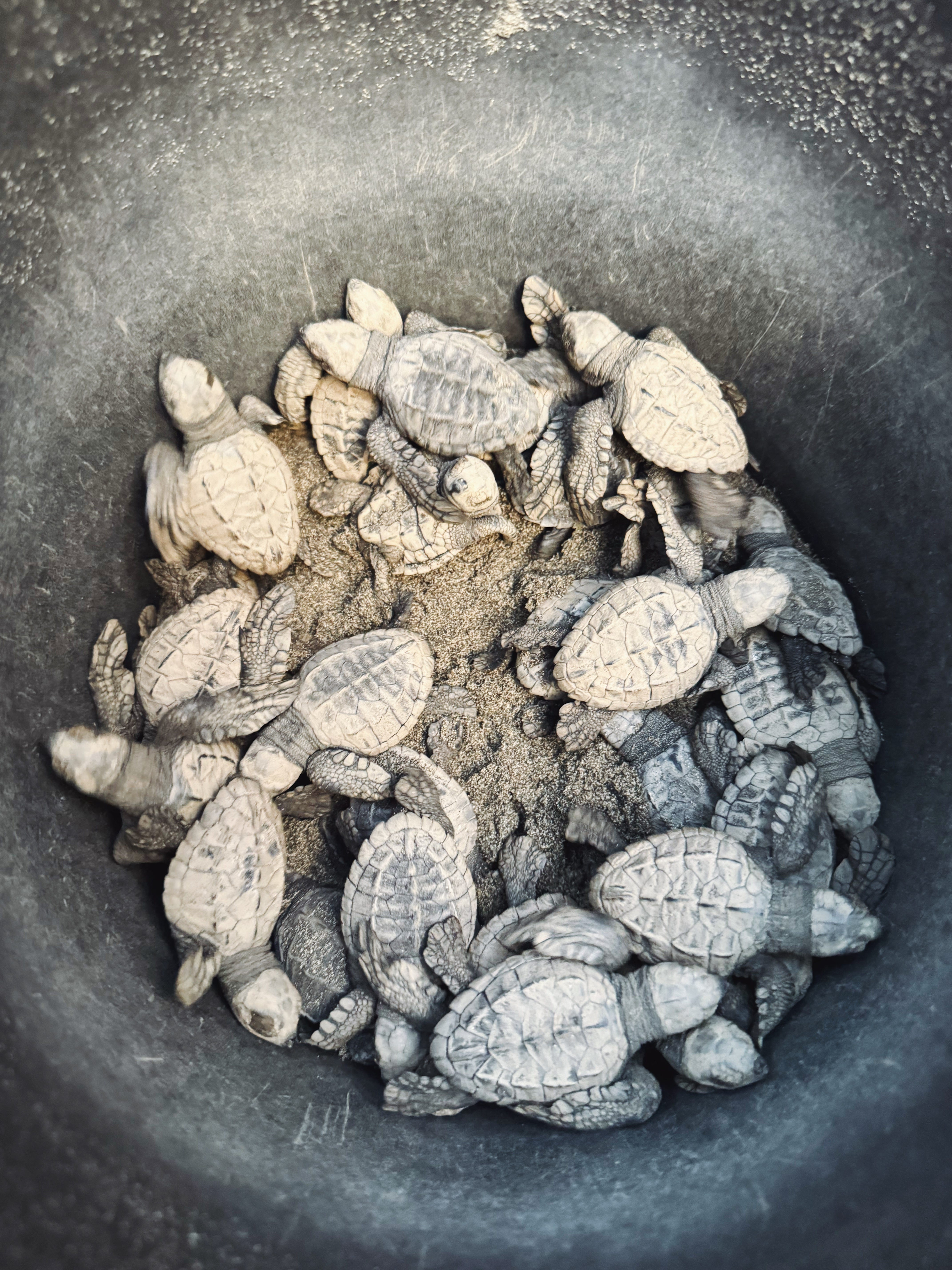
We drove down the mountain from Platanillo to Ventanas Beach in Ojochal. We got there and met Ceci, a marine biologist from France, holding a black bucket with about 60 recent hatchlings. The sunset was gorgeous, with red streaks painted across the waves. We crossed a small river flowing into the sea, followed her to the release spot, and just watched as sea turtle after sea turtle crawled slowly towards the ocean.
Seeing a baby sea turtle find its way to the sea is something every human should experience. It makes you feel hopeful, even knowing most of them probably won’t survive to adulthood. You see this tiny speck of a being making its way into the most enormous ocean. It’s the ultimate underdog story. Nature’s version of David vs. Goliath. The odds are stacked against them.
We might never see any of these turtles again. But a surviving female may one day return to nest near the beach where she hatched, guided by a navigation system scientists are still trying to understand. The males generally spend the rest of their lives at sea.
I imagine it is akin to what we will feel when we watch our kids drive off to college or make their first move away from home. It’s slightly terrifying, life-affirming, and all you can do is pray that luck will be on their side. The difference is that, by one rough estimate, only one in a thousand sea turtle hatchlings will survive to adulthood. And they don’t have any adult sea turtles chaperoning their entry into the world, just a group of useless, landlubber humans cheering them on. We were instructed not to move, but it’s hard to tell a 4-year-old not to move, especially with a baby sea turtle crawling over her foot. She ended up lifting her foot, and I just imagined this relatively giant toddler sole smushing this poor hatchling
“Don’t step on the turtle,” I intervened, too late. She didn’t. She stepped into the turtle’s path again, not directly on top of it, providing yet another obstacle between the turtle and the sea.
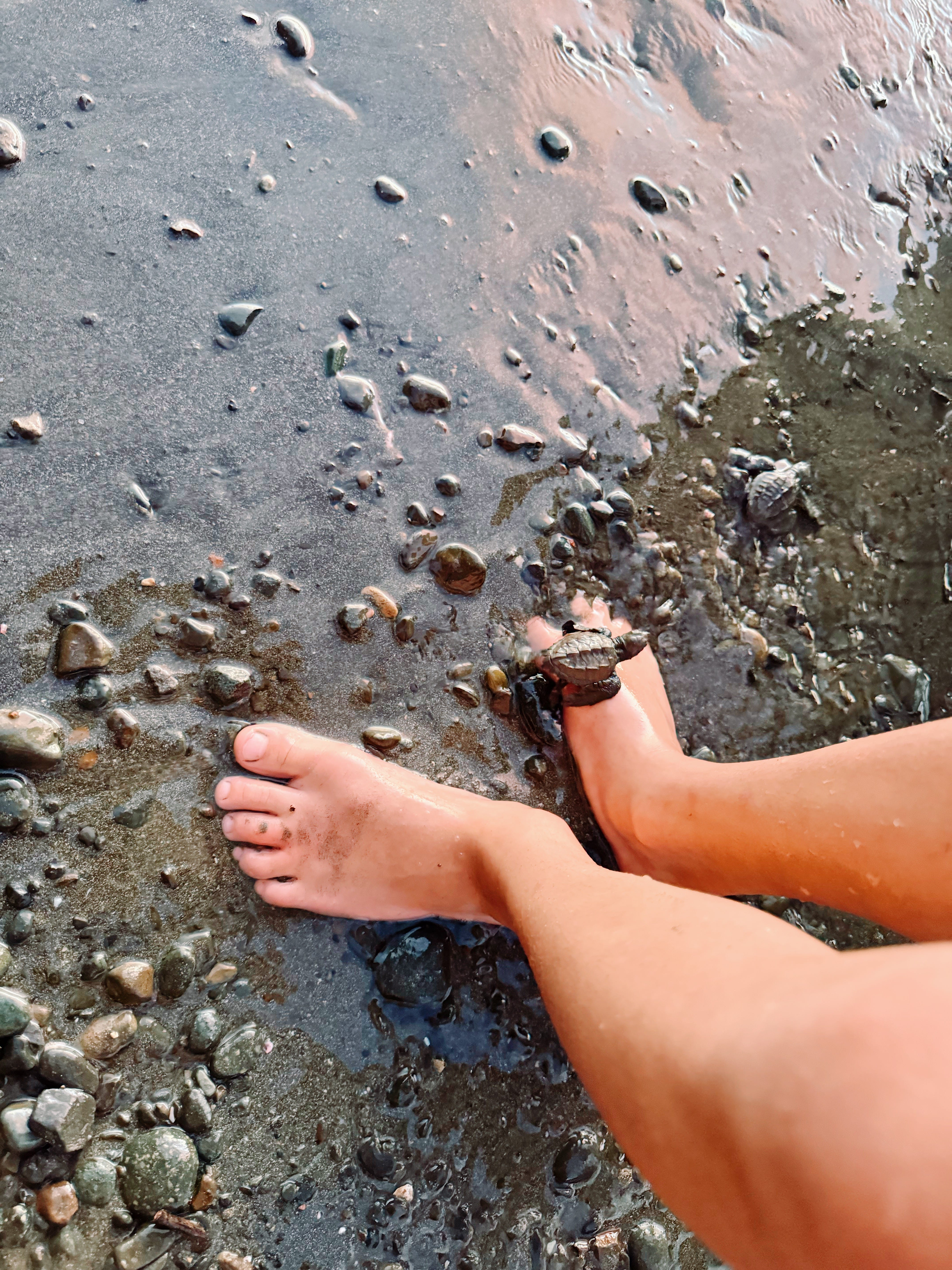
Alas, the turtle made it over Mt. Toddlerfoot and into the surf. Several agonizing minutes after they began their crawl, they were all gone, swallowed by waves crashing over the black volcanic sand at dusk, their tiny bodies carried into a new, dark, and dangerous world. As they hit the water for the first time, tears welled in our mammalian eyes. For a moment, I wondered what the world would look like for turtles and humans twenty years from now, when my kids and these turtle babies were grown. Somehow watching this million-year-old rite of passage reassured us that everything would be alright.
“Vaya con Dios,” was all Dana could muster. A wishful prayer and a nod to the final scene in the film Point Break. Go with God.
There’s an important lesson here. As fragile as life and species may be, natural systems are strong. In a confusing world where we don’t know who or what to trust, we can trust nature's laws.
After the last turtle disappeared into the black ocean, we went out for a celebratory pizza. We clinked our plastic cups of ice water and toasted to sixty more olive ridleys out there in the ocean. Sixty audacious acts of hope in the world, swimming around looking for their first meal, trying their best to defy the odds.
We slept with full bellies and hearts that evening. We dreamt big ocean dreams.