


This is the story of two juvenile scarlet macaws who were snatched before they could grow a single feather. I’m talking chicks so young Epstein would have refused them. But for wildlife poachers intent on capturing one of the most valuable birds on the black market, the younger, the balder the better, which made these tiny hatchlings ripe for the picking. And just like that, they were gone, taken from their nest and their mother, just days after hatching from their eggs.
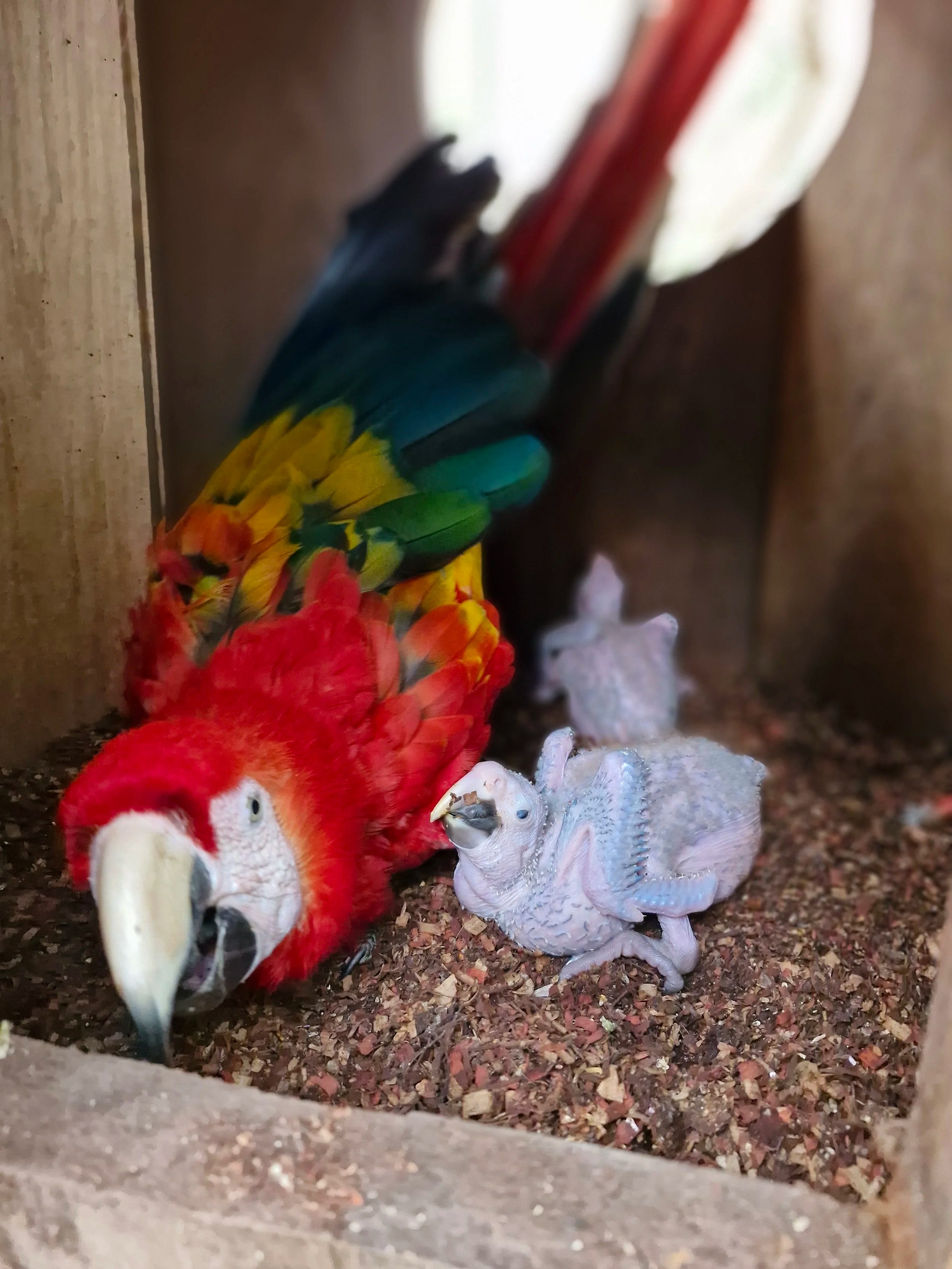
When this sort of thing happens to humans, any decent person would be outraged. But when it happens to animals, even supremely intelligent ones like the Scarlet Macaw, we don’t seem to bat an eyelid. Is this morally consistent?
I’ll conclude the story of the two fledglings in a minute, but it's pretty fair to say that this story did not make the front page of any newspaper or make a meaningful dent in the algorithm. There is simply too much going on. The world seems particularly violent lately. The news hard to watch. Cluster bombs were dropped on an elderly couple’s home in Israel, who were unable to get to the shelter on time, murdering them as they slept. Tomahawk missiles were launched at girls’ schools in Iran, murdering children as they studied. Social media platforms are being prosecuted (finally) for harming children. The list goes on and on. It’s hard to make sense of it all.
And as we continued our journey with our kids in the seemingly distant planet of the Costa Rican jungle, I tried to. I began thinking about these news events, prologues for the stories that defined my professional life for decades. My past life as a war correspondent covering the Middle East, on the face of it, draws a sharp contrast with what I’m doing now with my family in Earth Parade. In terms of personal safety, there is no doubt that I’m far safer in the jungles of Costa Rica, surrounded by jaguars, caiman, and pit vipers, than I was in the Middle East, surrounded by rockets, gunfire, and terrorists.
But upon reflection, I’ve come to understand that there is an overarching theme that spans both of these seemingly disparate chapters of my life, one that concerns a value I hold dear to my heart. It’s the idea of “sanctifying life”. It is why I needed to observe the Middle East up close, and why my family and I chose to visit the less newsworthy frontline between “civilization” and the wild.
Pay attention to the world around you. Are decisionmakers harming or sanctifying life, whether it’s human, flora, or fauna? Are your own personal decisions harming or sanctifying life? I’ve found these questions to be a very simple and useful ethical framework to carry with me as I try to make sense of a complex world. Is the invasion of Iran harming or sanctifying life? Is the proposed Port Everglades expansion harming or sanctifying life? Is abortion harming or sanctifying life? The answers are not always simple.
But I’ve come to realize in life that asking the right questions is more important than knowing all the answers. And while my family and I have been navigating so much personal uncertainty, I take some comfort in the knowledge that, despite the terrain being different, my most fundamental set of questions hasn’t changed much. We shlep our family to jungles, rainforests, and ocean passages to learn about and I take some solace in the fact that I’m asking the same question I’ve been asking since I started my career in journalism in Gaza 21 years ago.
The question touches on an ancient ethic, dating back 3,000 years, central to the moral and spiritual teachings of Hinduism, Jainism, and Buddhism, that teaches compassion, respect, and reverence for all life forms through the concept of Ahimsa. In the Judeo-Christian tradition, only humans are made in the image of God, but I was taught in my yeshiva that animals and plants are also part of God’s creation. Noah famously saved them 2 by 2 in his ark. And I always found it particularly godly that animals were supposed to rest on the Sabbath, too.
So when it comes to wiping out thousands of acres of primary rainforest for agriculture or development, how is it that we have strayed so far from this basic ethic? Yes, some humans gain wealth or greater access to food, but in the long run, we’ve seen that, aside from the moral question, destroying the countless lives and resources embedded in just one acre of primary rainforest is a net loss. Development and farming can happen elsewhere, but if we decimate these hubs of life, it’s very difficult to get back, and the losses are profound, sometimes eternalEarthre is possibly no more vivid example than one of the most strikingly beautiful and recognizable creatures on Earth. A bird known for its radiant color and intelligence. A flamboyant, raucous, and too noisy for their own good type. We all know one of them :).
The species I’m referring to is, of course, none other than the Scarlet macaw (Ara macao). When I learned that human beings nearly wipeEarth this iconic species throughout its endemic range in Central America, I realized that there is no species on earth that is truly safe, including our own.
Take a look at the map below, which illustrates how the illegal pet trade, along with development, led to the near extinction of these majestic birds in Costa Rica, where they remain vulnerable to this day. The map above shows their range roughly 100 years ago, and the map below shows their far more limited range today.
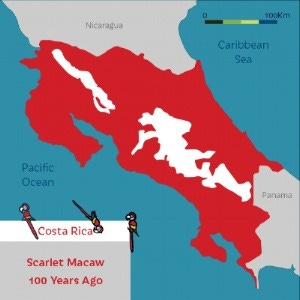
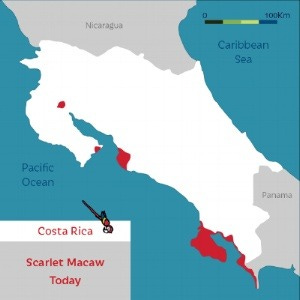
On the less scarlet map below, you can see that the still-red peninsula jutting out from the mainland. This is the Osa Peninsula which contains Costa Rica’s largest national park, Corcovado. Had they not conserved this territory in the 1980’s, there is a good chance these birds would have vanished from Costa Rica. In many other parts of Central America, including Southern Mexico and Northern Guatemala, where the two bald hathclings came from, they were nearly wiped out entirely.
How did this happen?
Poverty and lack of protection in resource-rich areas will always lead to a tragedy of the commons. Because of their dashing looks, intelligence, and the fact that they can live for 75 years, a single chick can fetch up to 15,000 dollars for the final purchase of one by a pet owner, often enabled by social media, in Europe or North America. They are among the most expensive birds in the $20B illegal wildlife trade.
And tragically, they are relatively simple to track. Despite their radiant looks, it’s often their noises that give them away. They make this terrifyingly loud “RAAAAK”! sound designed to keep them in contact with their mates over long distances as they fly through the rainforest. It’s unmistakable. They can be heard from kilometers away. If you hear the sound, look up, and you may see a pair of them flying together like a double streak of red light across the sky.
But what was an advantage for scarlet macaws’ survival became a disadvantage in the 20th century, as agricultural and development projects took over more and more primary rainforests in Central America. Due to their general noisiness and bright colors, and their propensity for nesting in the same large, old Mountain Almond (dipteryx panamensis) trees every year, scarlet macaw nests became easy targets for poachers, who were able to command high prices for chicks, often hundreds of dollars each for the local poacher who transacts with middle men who have access to trading networks and can smuggle them abroad.
Costa Rica is fortunately doing better than its Central American neighbors in this regard. The strong eco-tourism industry keeps land protection strong and smuggling operations mostly out of business. The number of scarlet macaws appears to be rebounding in the Pacific side of Costa Rica. ornithologists in La Cangreja national park counted 2121 macaws in 2023, up from prior years. Their range has expanded since the 1990’s when they feared local extinction.
If you go close to the Osa peninsula, or spend some time on the beaches near Ojochal, there is a decent chance you will see them, or hear them at some point. We managed to see them in flight several times, but they’re gone in an instant like parallel sqwaking red laser beams streaking across the blue sky.
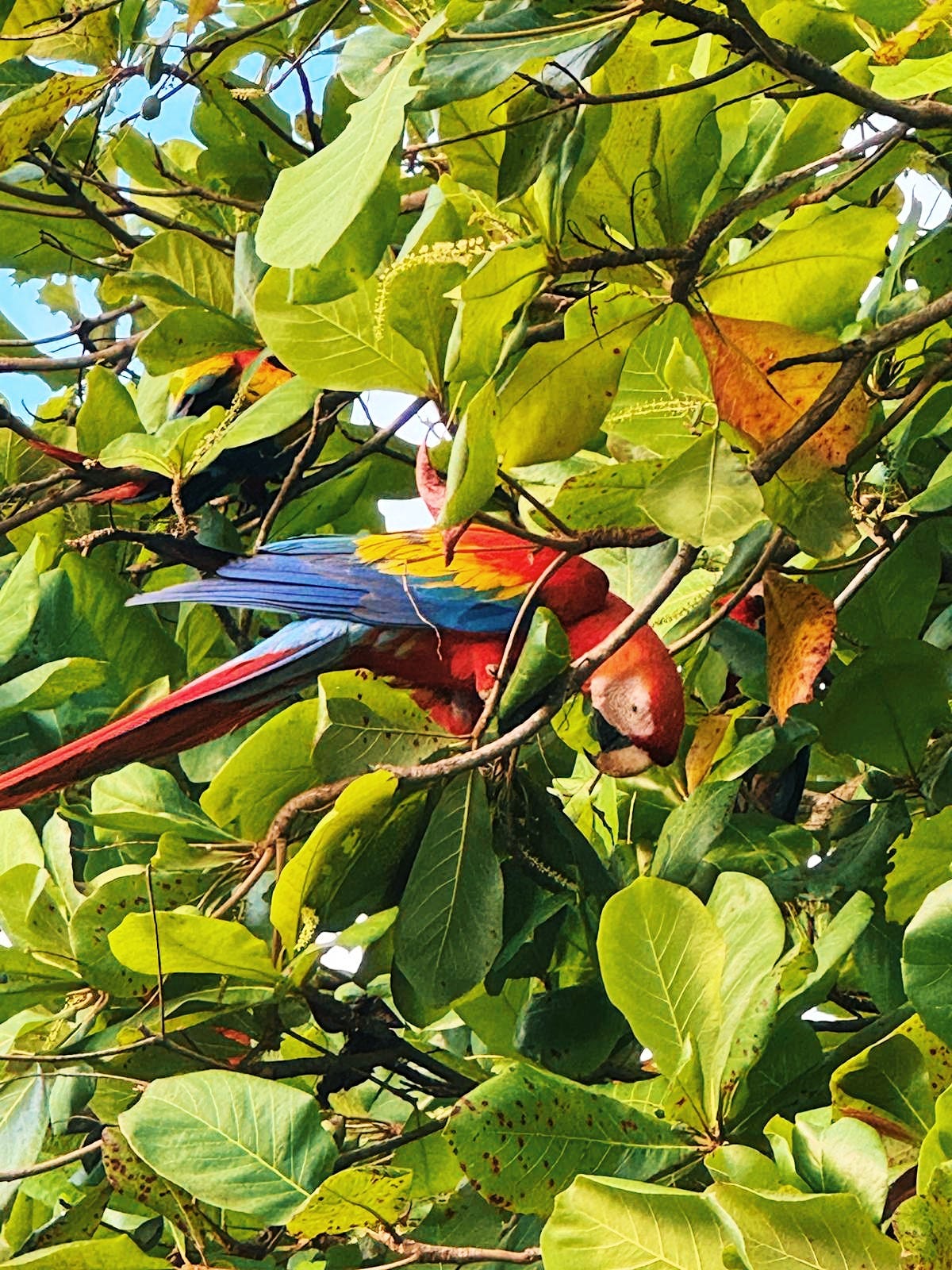
We were so fortunate to have one special encounter in which we got to observe them up close for a while, watching them feast and interact with each other. It was New Year's Eve, and we had just come back from a ziplining trip with some friends who were visiting from out of town. We were stuck in traffic after a big truck was immobilized and blocking the one lane on a bridge on the coastal highway just outside of the Osa. I put the windows down to let in some fresh air and my kids heard them first. You usually hear them before you see them. They sound like the raptors in Jurassic Park. “Look, Dad, Macaws!,” they screamed.
Sure enough, there were four of them in a single tree, two couples on a double date, eating the wild figs of the ficus tree. Nobody else stopped to notice them, but we sure did. We were so lucky to be stuck in traffic right next to the tree, so I gave my kids my iphone to start snapping photos from the backseat passenger side of the car. It was the best traffic jam of our lives, and we didn’t want it to end. We got to observe them for a full 15 minutes until the road cleared. We observed their neck strength and acrobatics, how they use their beaks to climb and crack things open. Their loud vocalizations. Their playfulness. Their personalities. Their brain power. And their wild color palette up close.
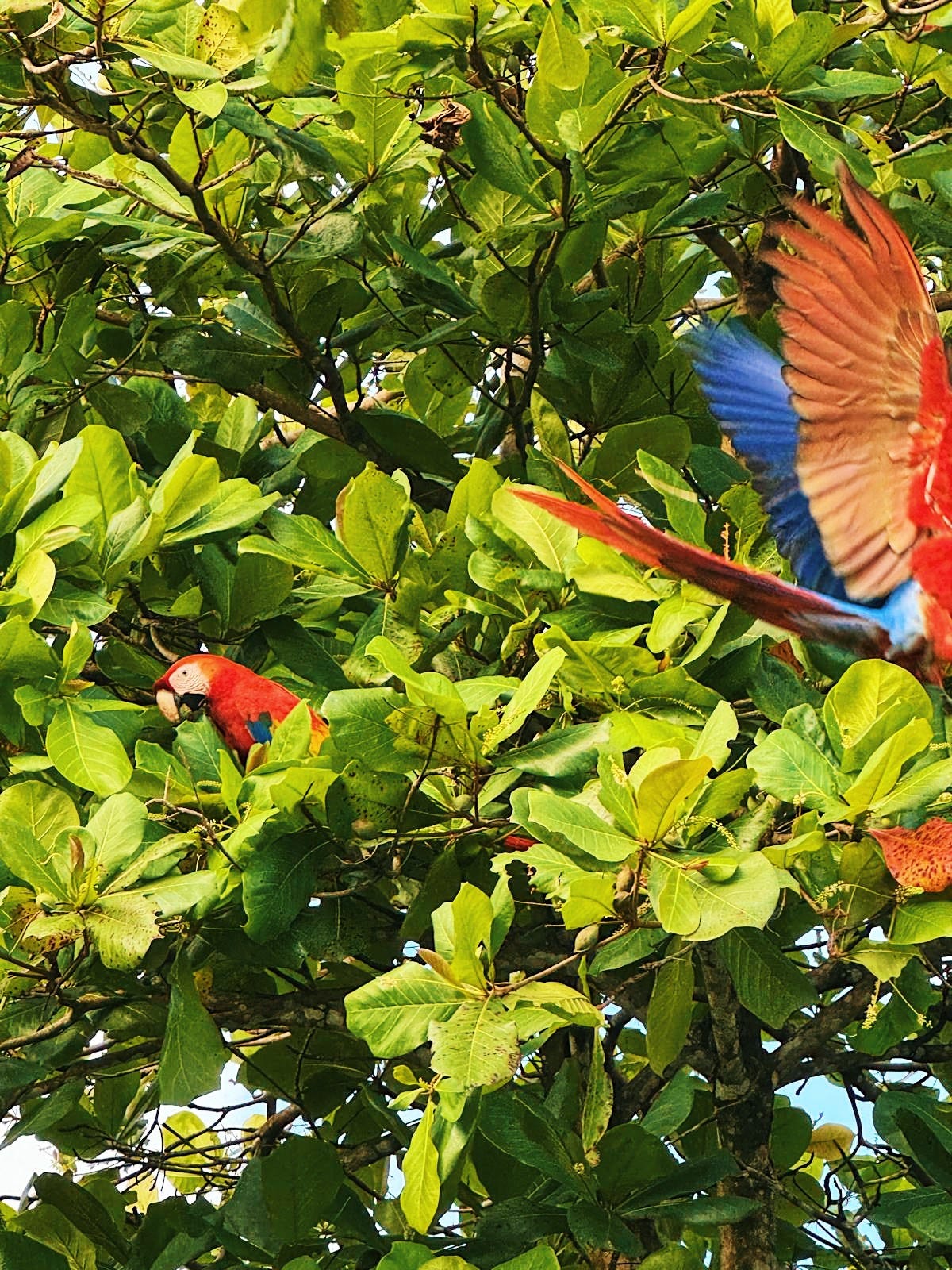
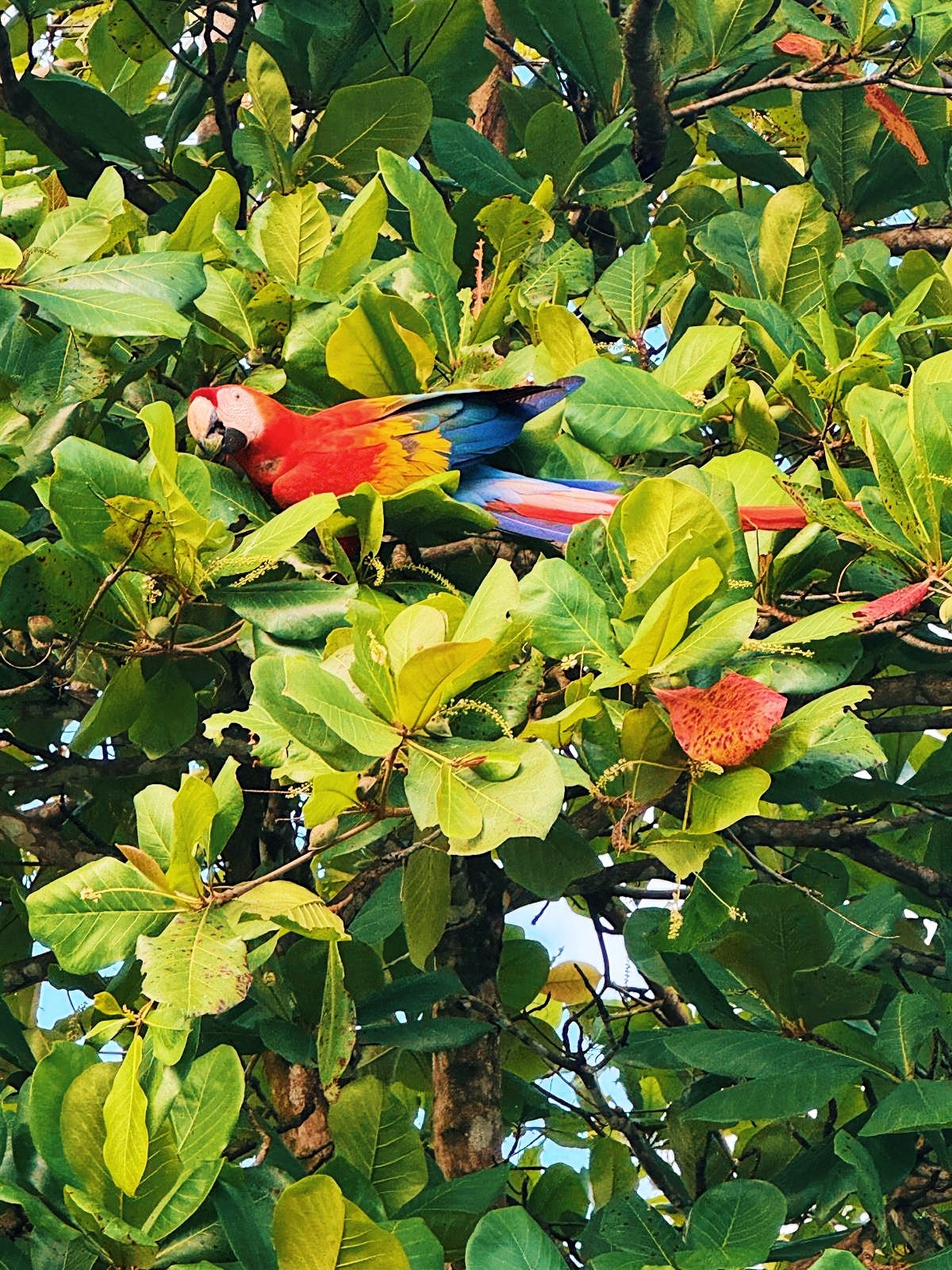
Seeing these four macaws doing their thing lifted our spirits and gave us tremendous hope for their future in Costa Rica. And I couldn’t help but think back to a book I read in high school, which I tried to recall and summarize in an age appropriate way for my kids on the way back. For you American Literature nerds out there, or just the slackers who read the cliff notes of Nathaniel Hawthorne’s famed 18th century novel (not saying im guilty) to pass Engligh class in high school, I’m referring of course to “The Scarlet Letter.” In the same way that the novel The Scarlet Letter came to critique the dominant Puritan morality of its time, my hope is that these birds will become a modern day scarlet symbol, raising questions about the dangers of neo-liberalism run amok. If anything can be gained from their near extinction here, may it be that we remember to ask ourselves the critical question of our time. Do our actions harm or sanctify life?
So what happened to those two devilishly cute hatchlings you may be wondering in the photo at the top? These two chicks were very, very lucky. Guatemalan officials somehow managed to rescue 19 scarlet macaws, including that featherless duo, from poachers and cared for the them until they were ready to be released them back into the wild. Watch the video below. It will be the best thing you watch this week.
Thank you for sharing this, Jaron. I'm so glad you and your family got to see the Scarlet Macaws. The video did lift my spirits. Each time you post, I understand a little better why you and Dana decided to give this gift to yourselves and your children. Now I also see how your sharing can affect change in our world. I have to say that I was deeply upset by this post. I'm sad and angry. I'm going to research more about wildlife trafficking and find out if there are more ways I can support the work of the organizations that are fighting it. Be safe, keep fighting the good fight. I can't wait to see your next post. God bless you and your family on your travels. Carole