


“Hola, me llamo Jerónimo y soy papá de 3 niños pequeños en una familia de 5. Nos gustaría hacer una caminata para encontrar ranas raras y venenosas en la selva tropical de Costa Rica. ¿Puedes ayudarnos?”
(“Hi, my name is Jaron, and I’m a father to 3 small kids in a family of 5. We would like to go on a trek to find rare, poison frogs in the Costa Rican rainforest. Can you help us?”)
That was the question I asked an expedition guide I’d never met on a WhatsApp audio call.
(For those Spanish readers out there, Jerónimo has been my adopted Spanish name since I was a pre-teenager growing up in Miami, a survival tactic that made it a lot easier to order a Publix sub in Hialeah.)
“Si, claro’”
(“Yes, of course.”)
Hearing that it was possible, a rush of excitement flowed into my brain, but at the same time, my paternal heart sank a bit. My subconscious mind began churning for the next question to ask this perfect stranger to trust him enough to introduce my most precious loves on planet Earth to toxic amphibians. I needed a bit more reassurance.
We had just arrived on the South Pacific coast of Costa Rica a day earlier, after a frantic 24 hours braving toxic traffic and shady car-rental operators in San Jose. After feasting on a freshly caught, flaky mahi-mahi in a coconut sauce for a late lunch, washed down by frozen watermelon batidos (smoothies), we were driving out of town on a dusty, bumpy, unpaved road back to our Airbnb, ready for a siesta, when a print ad caught my attention. It had some cool animals on it, including a tapir and a striking red frog, with the words, “Uvita and Dominical Night Tours.” I took a photo of the sign and called the number as soon as we got home.
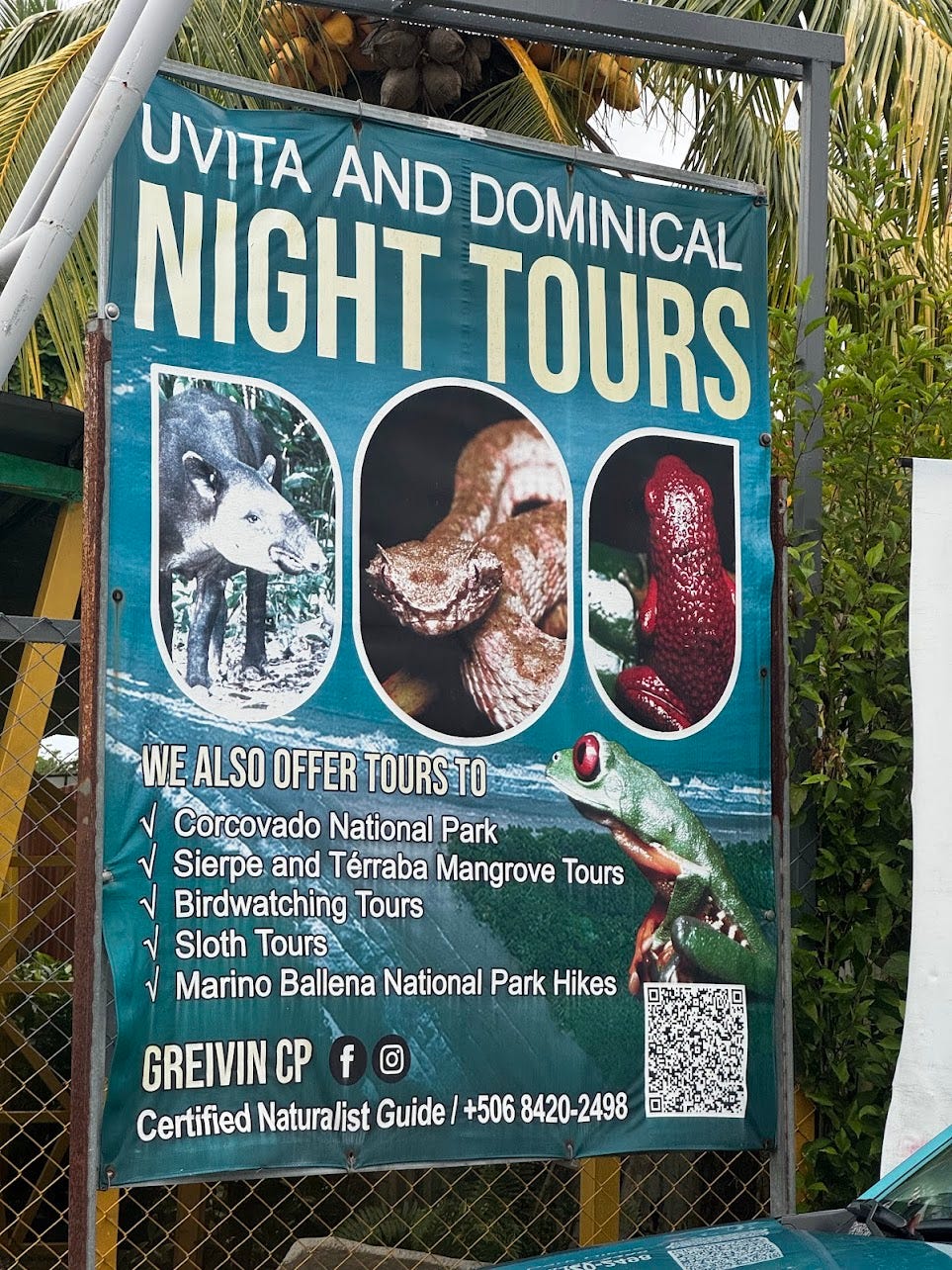
A male voice picked up, a guide named Greivin, and I asked about the standard night tour, which sounded amazing and something we would love to do on a later date, but I told him we were actually looking for some very specific, highly endangered creatures.
I had my ChatGPT queries open, so I didn’t bumble the scientific names.
“Estoy buscando la Oophaga granulifera, Phyllobates vittatus y el Dendrobates auratus. ¿Los encuentran aquí?”
I basically asked him if some of the most poisonous frogs in Costa Rica can be found in the Uvita/Dominical area.
He said, “La verdad que no. Yo hago tours de noche y esas ranas se encuentran de día. Pero no te preocupes, conozco el mae.”
(Not really, I do night tours only, but don’t worry, I know the guy.)
He passed on the contact for a mae (Costa Rican slang for “guy”) named Raby.
The next day, I called Raby and asked him the question at the top of the page. When he affirmed that we can see rare, poison frogs, it was time to get into the specifics. So I asked about the Phyllobates Vittatus, the Gulfo Dulce Poison Frog, whose scientific name was the easiest one for me to remember because it rhymes.
He said in pretty fluent-sounding English, Yes, I can show you this frog. And most likely we can also see the Oophaga granlifera, the granular poison frog, and the Green and Black Poison Dart Frog (Dendrobates aurates), which is more common.
All 3 in one outing? Is that actually possible?
“Anything is possible in the jungle,” he answered, chuckling.
I laughed nervously.
“Seriously?” I wondered if this guy was for real.
“Yes, this is one of the last remaining habitats for these frogs in the world, and you can find them all here. I am a professional, certified tour guide, herpetologist, and an expert on these frogs. When do you want to go?”
“Well, there’s a small catch: I have small kids, including a 4-year-old little girl who can hike for a couple of miles on a good day. You sure it’s ok? Is it dangerous?” I asked him.
“I don’t think so,” he said.
I didn’t love that response, so I grilled him a bit more.
I asked him what the worst thing that could happen was. He said that it’s like any other river hike in Costa Rica.
“So the worst thing would be slipping and falling on a rock, especially if it’s the one with a Fer de Lance (the notorious pit viper), hanging out below it?”
He chuckled.
“Exactly.”
I asked him if there were any recorded human deaths from these frogs.
He said no.
Finally, I got to the most pointed question of all.
“Would you take your own kids?” I asked him.
“Yes, I would, because I’ve participated in research that has confirmed that the Golfo Dulce produces relatively weak toxins, and there have been no recorded human deaths or serious poisonings. It produces batrachotoxin-related alkaloids, the same toxin family as the deadly Colombian frogs, just in much lower doses.”
“Seems like a family-friendly expedition to me!”, I blurted aloud excitedly.
This was the assurance I needed, and having already done lots of river hikes here with my kids, I figured there was little more risk in this little expedition. We agreed on a price of about 75,000 colones, or roughly $150, for leading us to see some of the rarest poison frogs in the world. It seemed like a bargain.
The reason these frogs are so endangered is partially that they live only in a very small geographic range: the South Pacific lowland rainforest of Costa Rica and Northern Panama. And unfortunately, so much of this precious habitat was cleared for agriculture (palm oil, bananas, cattle), roads, and housing. Amphibians worldwide have been devastated by a fungus called chytridiomycosis, also known as chytrid fungus, and small populations like the one here in Costa Rica are especially at risk. Also, because these frogs have such bright colors, they were historically sought after by illegal pet traders.
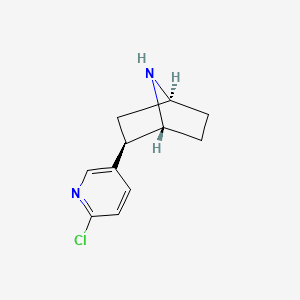
And here’s why saving these species might matter even more to the future of humanity: There is a cute little poison arrow frog called Anthony’s Poison Arrow Frog (Epipedobates anthonyi) found only in Ecuador and Peru. Research on this rare frog led scientists to discover epibatidine, an extremely powerful alkaloid found in its skin, which became a research goldmine. It helped scientists understand how pain signals travel, advanced research on anesthesia, addiction, and nerve signaling, and inspired synthetic compounds that led to modern pain medicines that help so many people today.
.
The two frogs we are looking for today, on the verge of extinction, contain unique alkaloids that may also harbor undiscovered molecules or other valuable information for medicine or science. If we lose them, we not only lose a beautiful animal with inherent value that has evolved alongside us for millions of years, but also, perhaps, a more cynical reason for conserving them: we lose valuable information. A unique blueprint of life. A miraculous composite of creation. A potential unlock for humanity to live better, happier, healthier lives. Erased forever.
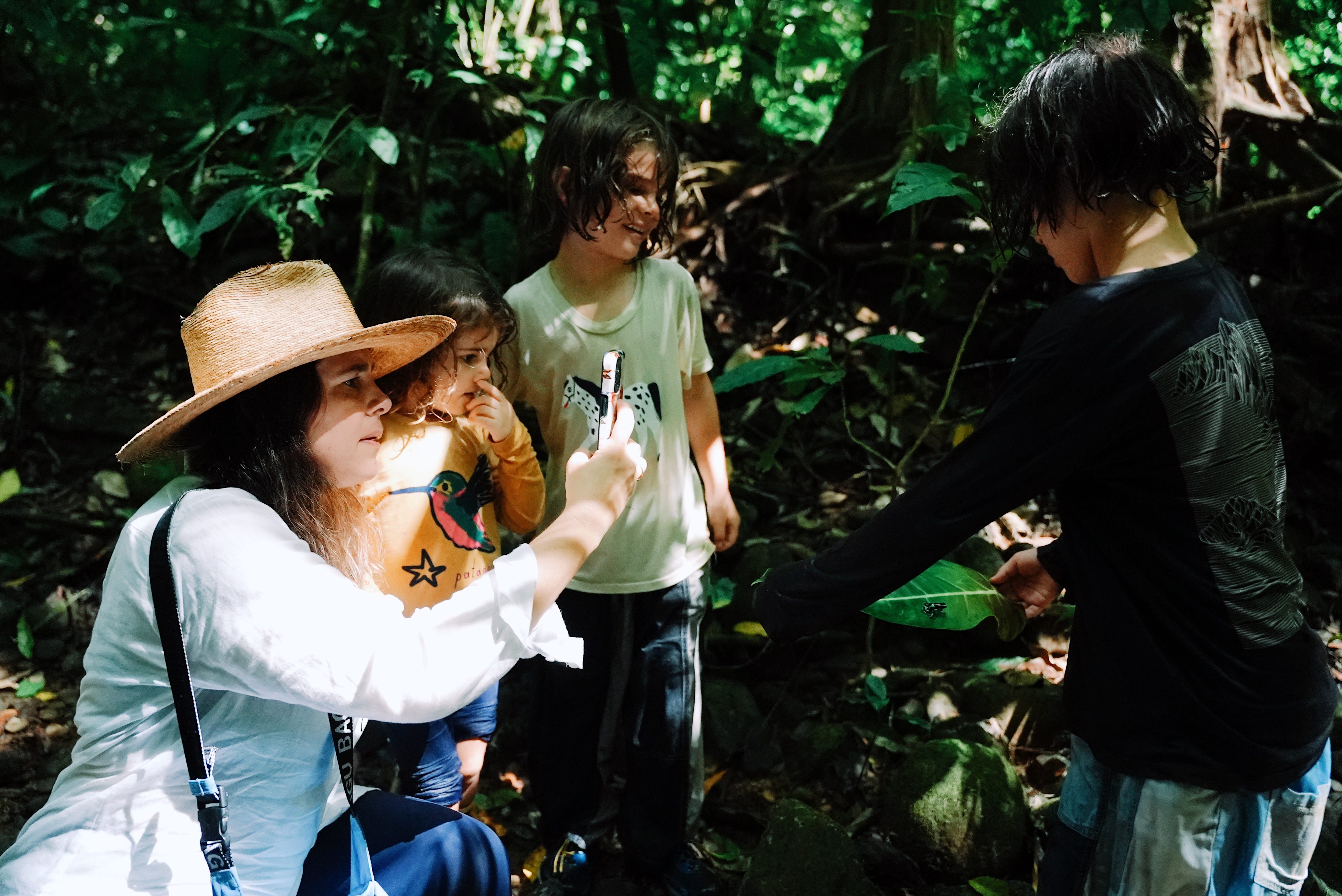
Which is part of the reason the stakes felt so high when, a few days later, we got up early and drove to Palmar Norte, where we met Raby, a guide, naturalist, and amateur herpetologist, in person by the Bank of Costa Rica. He was friendly, with a soft handshake and a warm smile, despite wearing a black guide shirt featuring the deadly Fer-de-lance pit viper. We followed him to a tiny dirt road that jutted up into the mountains, where he got out of his car and gave us instructions on how to find the meeting spot. He didn’t have a 4x4, and our SUV was packed to the brim with kids and gear, so he walked up the road just behind our car as we drove to the location. I felt bad, but he insisted.
15 minutes later, we met at the spot where we would hike into a little river gorge covered with primary and secondary rainforest and cacao trees. Apparently, they had been planted by farmers but abandoned. It was private land, but under Costa Rican law, once you are within 15 meters of a river or waterfall, it is considered protected public land. This is a good policy for protecting rare frogs.
We descended into the ravine. The boys hiked up ahead with Raby and Mom. I was with Vivi in the back, holding her hand strongly to keep her from slipping and sliding on wet rocks. Luckily, she’s wearing her Xtra Tuff boots from Alaska. She was a trooper and loved every second of it. The boys kept going ahead of the guide, and I was constantly yelling at them to stay behind him.
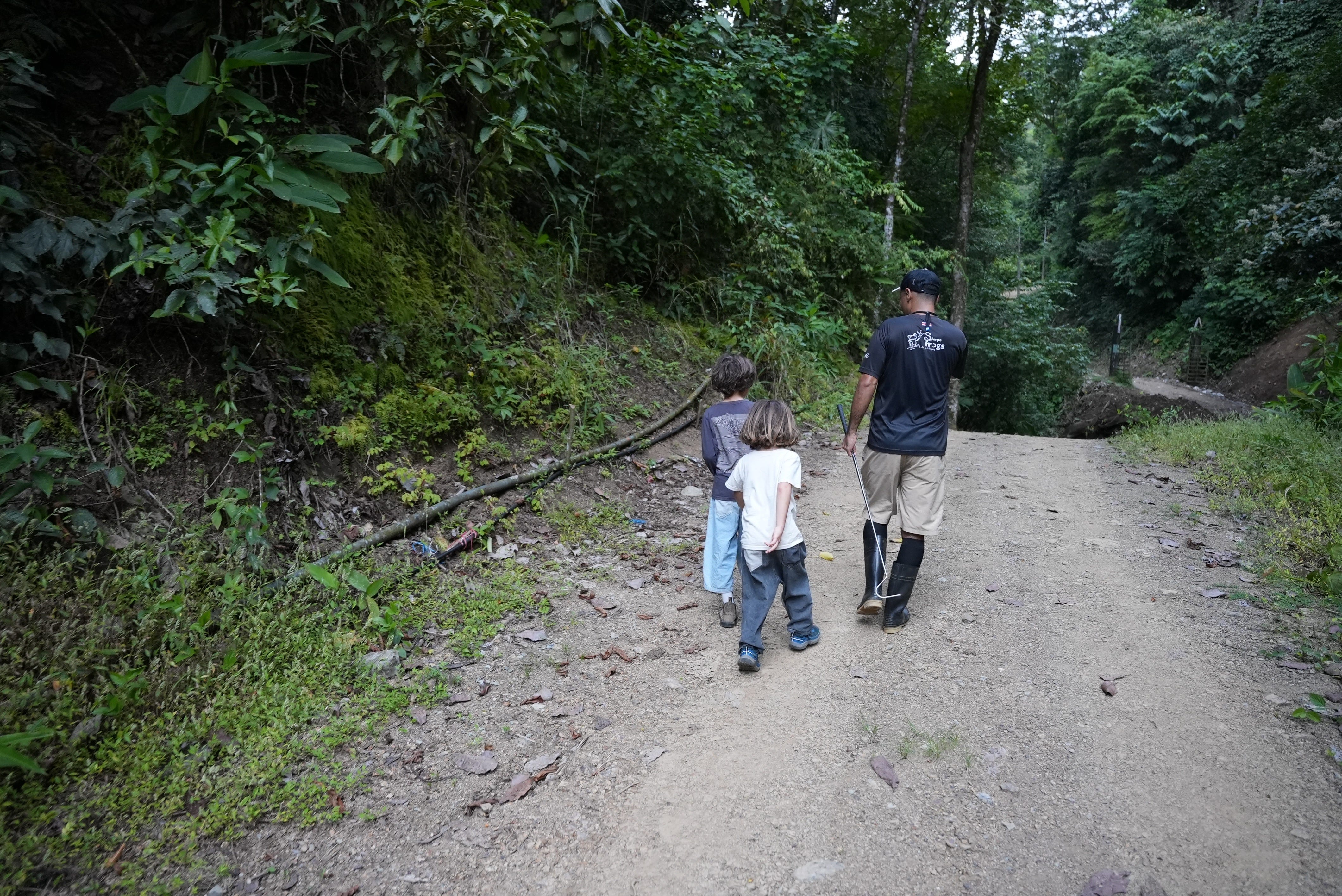
We are making 6 sets of fresh tracks on the muddy trail, breathing in the purest oxygen from millions of trees, and hearing the waterfall grow louder as we descend deeper into this river gorge. What started as a trickle of water has become a bit more intense, and we are now walking through little mini rapids. Eventually, all our waterproof boots get soaked inside and out. Raby is shining a flashlight on the river banks and the brown dirt walls of the canyon leading up to the road. After about 20 minutes of searching, he suddenly stops, “Aqui esta uno.” (Here is one). He shines his light on something.
We are so excited and focused on this muddy wall, trying to see what he is seeing with our untrained eyes. I squint and eventually can see a tiny red speck in a dark, watery mud pit towards the ground. I am looking at an animal so rare that maybe only hundreds remain.
We were immediately stunned by its beauty. We get a bunch of close-up shots with our iPhones, GoPros, and Sony long-lens camera. It’s hard to capture, partially because it's so tiny, but also because it’s got this granulated texture that doesn’t read as well through the lens.
We eventually put our phones and cameras down and just stared incredulously at this minuscule, stunning frog just hopping around. This is the moment we were waiting for, hoping for, and dreaming of.
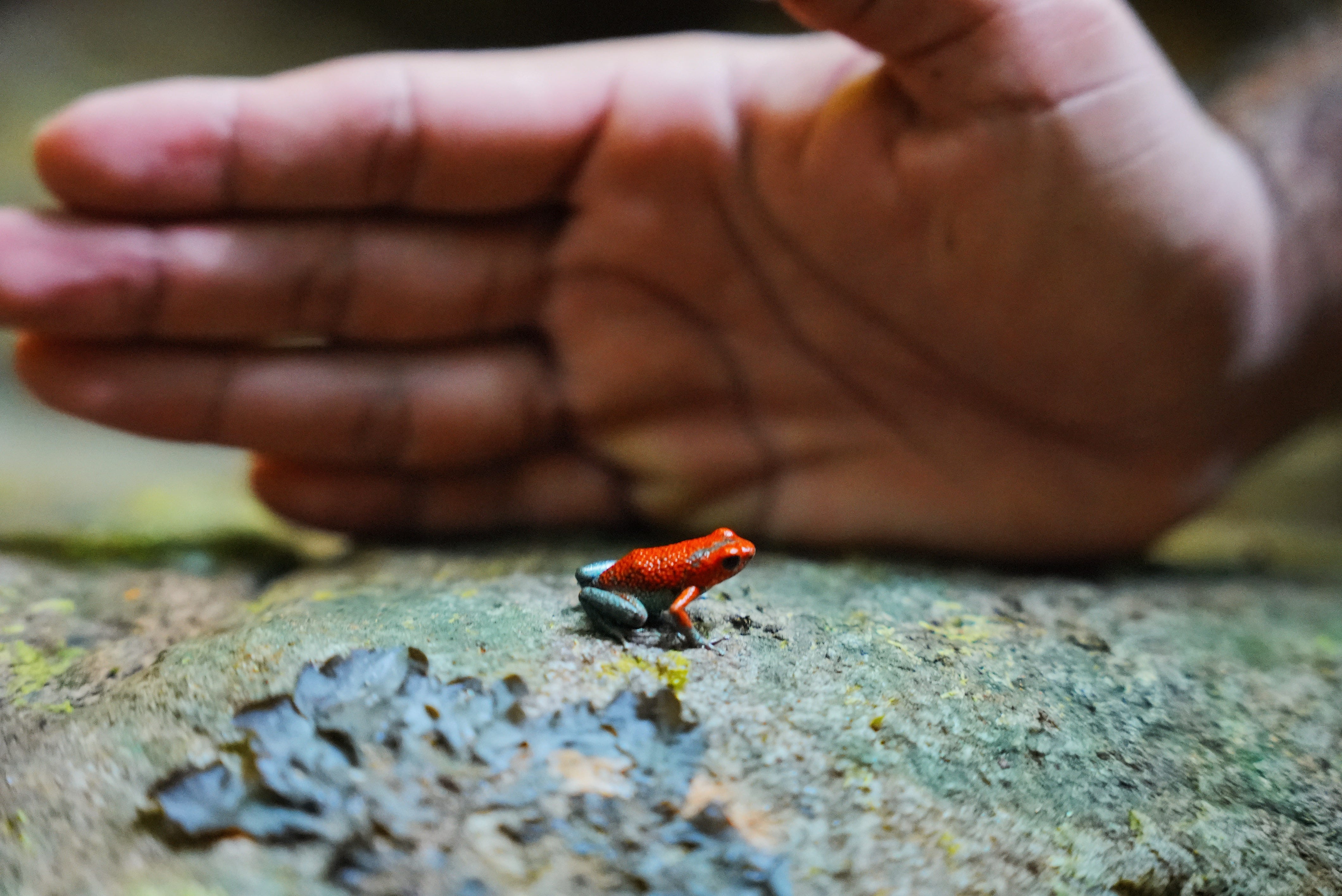
Suddenly, Raby picks the frog up with his bare hands. We’re all freaked out, but he explains that the toxins emitted from its back and spinal region are not deadly, and as long as he washes his hands afterwards, it won’t affect him at all. We learned that the skin serves as a barrier, so unless you touch the frog and then put your hands in your mouth, eye, or an open wound, you should be fine.
These very rare poison frogs are endemic to this region, and Raby knows them like the back of his hand, which he uses, not in a metaphorical sense, as a frog pedestal to show them to us. Immediately after handling the frog, he washes his hands in the river. He is often recruited for research studies to guide the more academically trained herpetologists to these Costa Rican poison frogs. He said they are not nearly as poisonous as once thought, but that we shouldn’t touch them as a precaution.
Sorry kids.
Raby tells us about the special Oophaga (which means “egg eater”). The mother of this frog lays special unfertilized eggs for their tadpoles to feed on. It’s a strong maternal instinct for reptiles. We observe it and keep on looking for more frogs.
The next frog we hope to see is a relative of the infamous Golden Poison Dart Frog (Phyllobates terribilis), found only near the Pacific lowland rainforests of Colombia. Those contain batrachotoxin, one of the most powerful natural poisons on Earth. The native Embera people used their venom on the tips of their arrows to make hunting more efficient. A single dart frog can carry enough toxin to kill 10–20 adult humans. I’m not sure taking my sweet kids to see that particular frog would be a sane decision.
No, no, no, don’t worry, grandmothers.
We’re looking for their relatively kid-friendly Costa Rican cousins (Phyllobates vittatius), which means “Striped leaf walker” in Latin, which do contain enough poison to make an animal regret eating it, but not enough for a human to regret touching it.
Suddenly, I saw Raby’s hand swoop down quickly on a rock, but the tiny frog that was there must have felt it coming, and it jumped just before the moment of impact, ricocheting its whole body against the giant human hand, before falling awkwardly into the river. The poor frog was floating upside down and being carried by the current into a rapid section, where we likely wouldn’t have been able to find it again. Luckily, in a second effort, Raby scooped it out at the last second.
And then he revealed to us, like a magician, that in the palm of his hand was Phyllobates vittatus.
And if Oophaga was striking, these guys may be even more beautiful. They are tiny, only 2-3 cm, and you really have to get up close to see them for what they are. But once you do, I think that anyone would be captivated by their beauty. Seeing them in the wild, doing their thing, made me ponder not only the genius but also the artistry of evolution. I sincerely hope that God/nature/Universe/WhateverYouBelievein somehow delights in the beauty of His or Her creation.
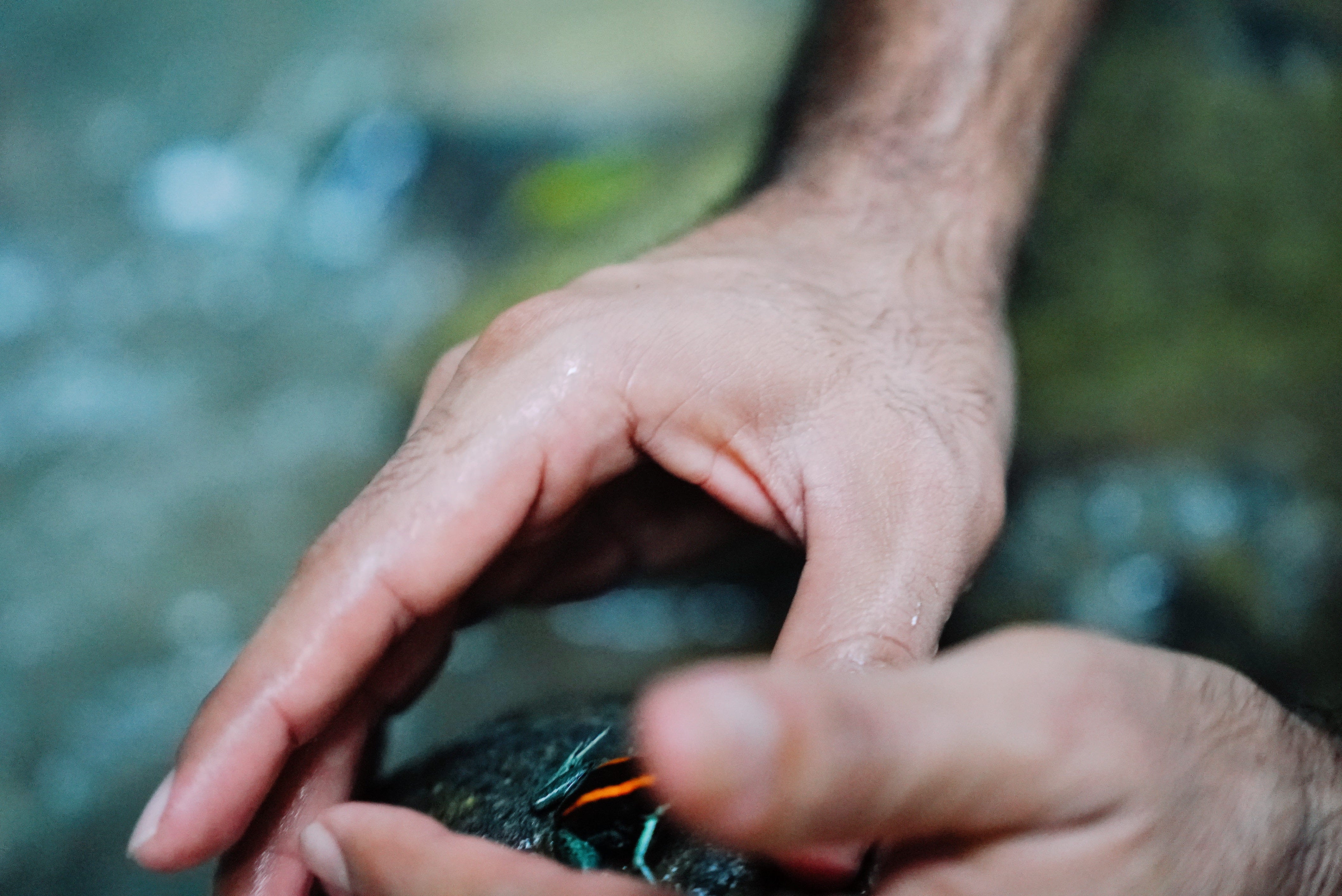
There was a brief instant with the frogs that felt like a transcendental, energising moment for a tired family. We were in a distant jungle, with no other humans in sight, witnessing this rare life form on the brink of extinction. And here we are, a normal human family, staring into its eyes, fully present and feeling so much love for this creature and for each other. The jungle went eerily quiet as we went into a flow state as a family, hyperfocusing on every detail of this extraordinary creature.
The fluorescent orange stripe running through its body. It has tiny webbed feet. It’s wide open eyes.
It felt so blissful, and so we just stayed there with it, with our guide, Raby, observing it, photographing it, witnessing its behaviours, asking questions. This feeling, this moment. It’s like nothing we ever experienced at a shopping mall, playground, family dinner, or doing anything else. For a brief moment, we were in unison. We were present. Witnessing the magic of creation, pondering the mystery of life together.
It’s a wonderful feeling knowing that right down here in this river gorge in the middle of a random rainforest in Costa Rica is exactly where we’re all meant to be. That there is a lesson, or some kind of gift that we are meant to learn or receive from all the efforts, energy, and suffering it took to get here, and ultimately, get back home.
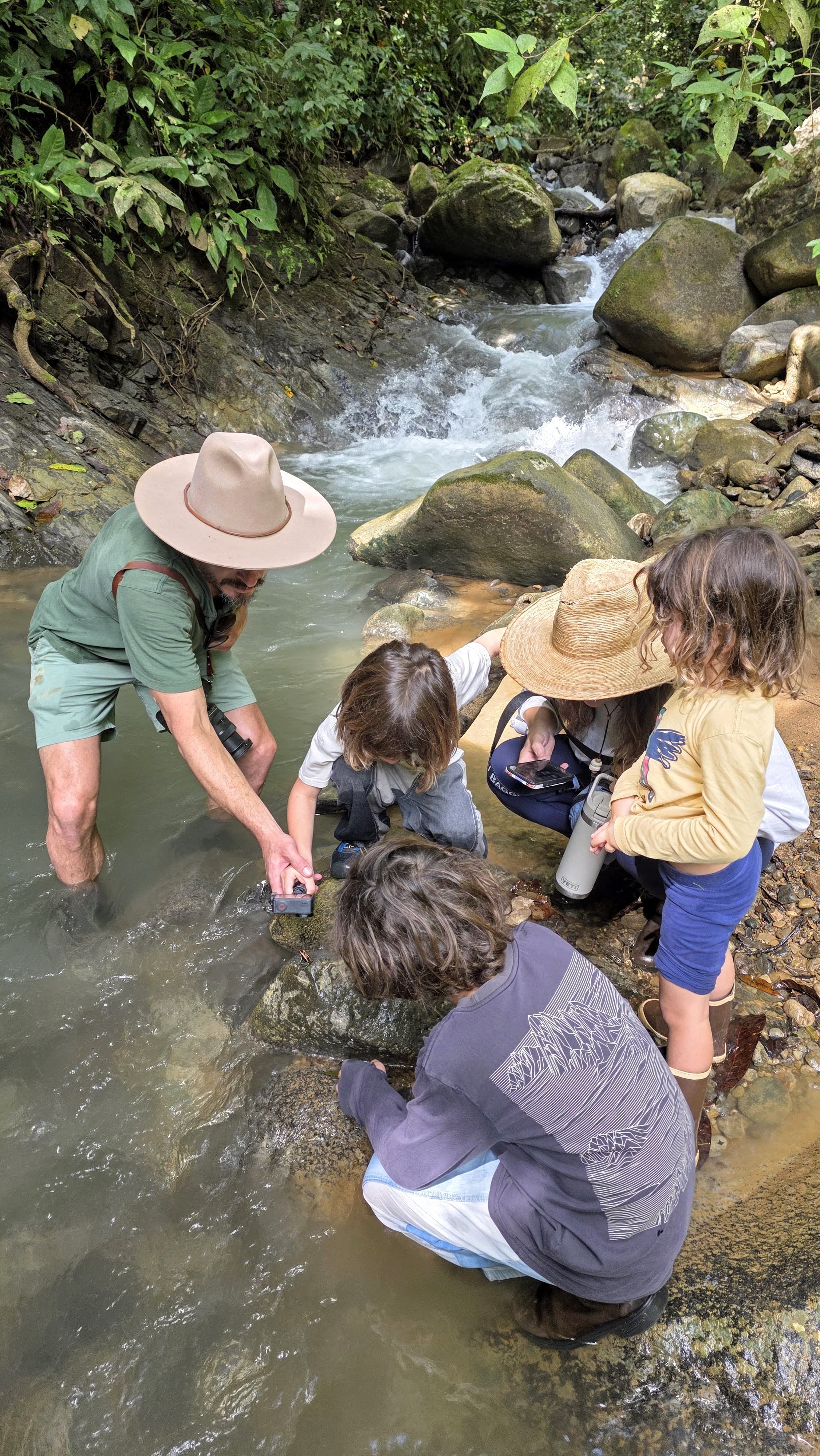
The moment ends when our kids try to touch the frogs, and we have to intervene.
Raby finds another Golfo Dulce. He lets the kids pick it up with a leaf. The boys do, and somehow the frog jumped off the leaf and bounced onto my son’s bare hand. We all panic a little, but Raby says to just wash it off, and Ori does that.
We take it as a sign to keep moving.
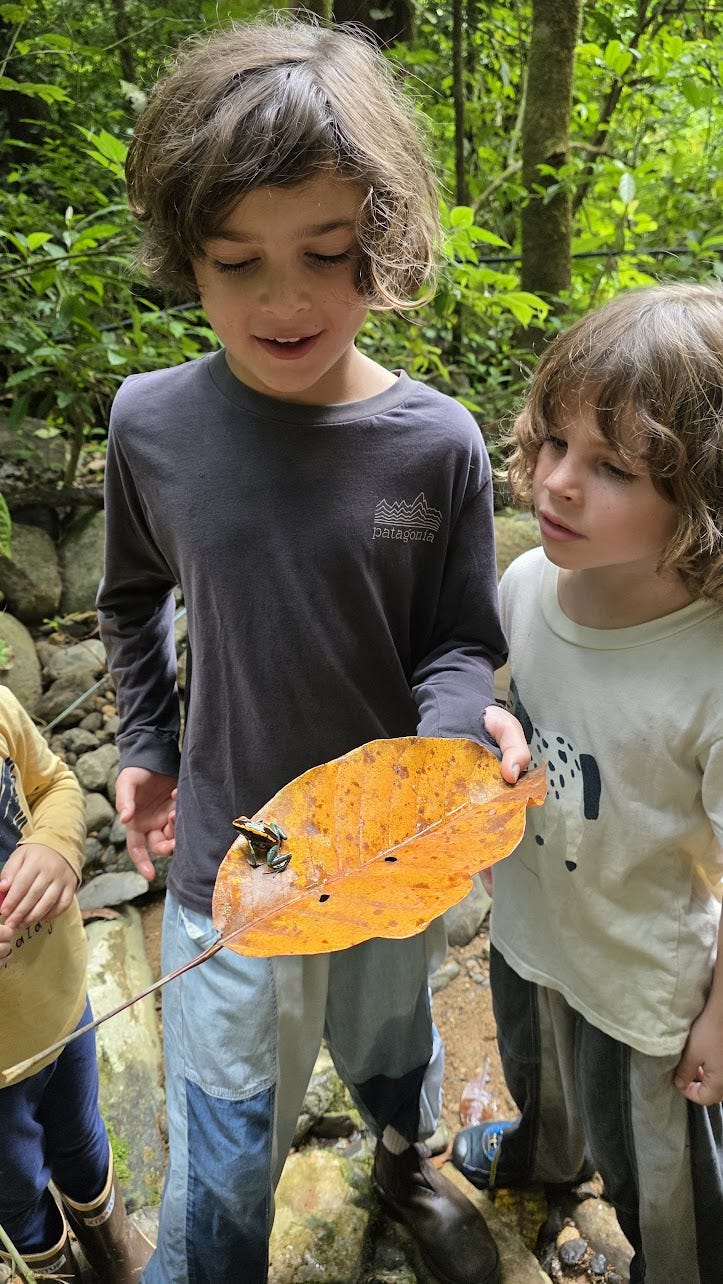
We walk towards a waterfall for a dip.
On the way, we see a green-and-black poison frog. And just as I thought I had seen the prettiest poison frog ever, we see another incredible, beautiful species.
3 for 3. Raby was right.
This one is more common than the other two, and for that reason, it won’t make it in our Creature Catalog, and that’s a good thing, because it’s not nearly as threatened as the other two species we saw that day. We later learned that this stunner is considerably more toxic than the other two. According to Raby, a fellow herpetologist friend of his handled one of these, didn’t rinse it properly before touching his sweaty brow, and apparently lost his sight for a week. Be careful out there!
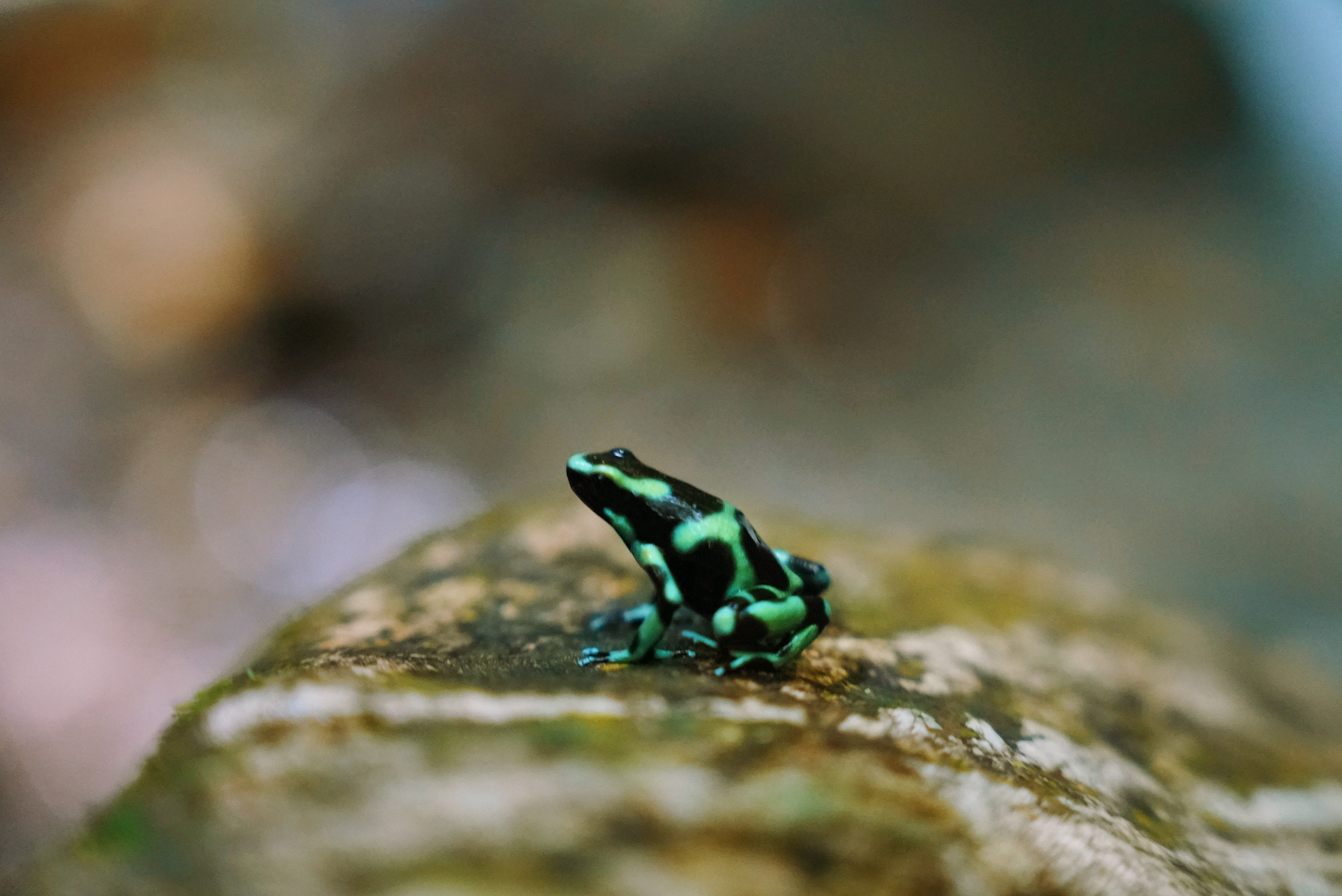
Then we found a pair of Golfo Dulce males fighting each other under a log. We observed them for a while, and he explained that they are actually pretty similar to male humans, fighting over territory and females. We made it to the waterfall and swimming hole and went for a swim. I submerged myself and then came up for air, exhaling deeply, full of gratitude after a successful and safe expedition.
One of the things we love to do after these encounters is to talk about the lessons we learned, either from the journey or from the creature itself. We talked about how these frogs needed to evolve to be striking and visually distinctive, because that’s the only way predators would leave them alone.
We learned from the frogs that conformity can get you killed. Be different. Be bold. Make yourself too colorful to eat.
We also learned from the expedition that sometimes, as humans, we fear the wrong things. We stay indoors because we fear the outdoors (the place where we evolved!). We hear about these dangerous Colombian poison frogs that can kill 10 people, and we make assumptions about all poison frogs. We prefer to remain ignorant rather than rush to save a creature that may contain life-saving compounds.
If you’ve made it this far, here’s the lede that I’ve hidden just like a tiny poison frog in the rainforest. It’s no panacea, but one key piece of the strategy for saving this frog, and indeed all the endangered species of this planet, is actually quite simple. It’s for all of us, or at least enough of us, to vacation differently. Skip the luxury resorts and over-priced strawberry daiquiris by the pool and instead book a herping tour with Raby. If enough tourists come to places like this, we can save it from becoming another banana plantation. Our tourist dollars speak volumes. And if you choose to come here, you are saying that these frogs are worth more alive than dead.
Costa Rica is not perfect, but with 25% of its land protected for conservation and a thriving eco-tourism sector, it’s making a strong case for how sustainable, well-managed ecotourism may be the best way to protect the planet’s most fragile habitats. We’re going to unpack this more in the future, but it’s both fascinating and inspiring to see the Costa Rican eco-tourism model “in the wild”, and see so many other nature-loving tourists coming to this country to experience something that is so hard to find elsewhere.
If you do come here and book a tour with Raby, do so at your own peril. If you see one of these frogs in the wild with your naked eyes, you won’t receive any toxins, but you may just receive a sacred experience to cherish for the rest of your days.
Thank you for this post! Great reading and excellent pictures. I get excited when I see that I have a new email from you. I'm still in awe that you all stepped out on faith to give yourselves and your children this extraordinary experience. This education could never be equaled in a classroom. As always, sending prayers for your safety and that you find those creatures in your catalog!
Really nice reading! :) Seeing poison dart frogs in the wild has always been on my bucket list. I hope someday I can visit Costa Rica and do something similar.