


I have a confession to make, and I hope you won’t judge me for it. Bear in mind, this is from an episode in my life before my prefrontal cortex, the part of the brain responsible for impulse control, fully matured. It is a tale from my rebellious teenage years, which, somehow, by the grace of God, I survived. Another disclaimer is that while these events are true, they happened almost exactly 30 years ago, so some parts are a bit fuzzy. And yes, there is a wildlife encounter embedded in here, along with some wisdom I hope can be ascertained, which are the main reasons I’m sharing it.
Ok, deep breath, here goes.
I was 16 years old on an upcoast surf trip with two buddies over spring break in South Florida (Yes, I know another regrettable Florida spring break story, quite the cliche). We had all just gotten our driver’s licenses and were still very much excited just to be driving anywhere. After a disappointing surf session near Fort Pierce, we were headed back to Miami in my friend’s brand-new, army-green 4X4 SUV. I’m not a car person, but I’m pretty sure it was a Mitsubishi Montero. At some point while driving south on A1A, near one of West Palm Beach’s wealthier areas, I took over the wheel from my friend. I’m not sure why we switched drivers. It’s highly possible that I convinced my friend, or that he got tired. I do remember him being asleep in the back when I made the unilateral decision to test out this new truck’s capabilities by driving it through the backyard of some coastal mansion, straight onto the beach.
I don’t remember seeing any signs warning against trespassing. I do remember my friends being very excited and slightly terrified as I carved figure eights in the moist sand at high speed, switching back and forth between two- and Four Wheel Drive and flirting dangerously with the incoming shore break, only to turn away at the last second. After a very brief and exhilarating joyride, I got the SUV stuck worse than I’ve ever gotten a car stuck in my lifetime. All 4 tires were suddenly and unceremoniously buried deeply in the softest, hottest possible Florida sand.
We looked for a 2x4 piece of wood or anything that could serve as a plank to miraculously catch the tread on the tires and pull us out, but there was nothing in sight. We considered using our surfboards, and maybe in hindsight we should have tried that. Instead, we kept trying to throw it in reverse and then forward again. The goal was to get some traction, but in fact, we were digging out more sand, achieving the exact opposite. We managed to bury the tires completely in the sand. The car’s chassis rested flush on the sand like a sunbather. To make matters much, much worse, the tide was coming in.
Someone must have seen a few young long-haired maniacs driving on the beach and reported us. I recall a policeman trudging a great distance over difficult terrain. I wasn’t sure if we were about to be rescued or arrested. He trudged awkwardly down some dunes and tall grasses, in the blazing Florida sun during the vernal equinox. I don’t remember much of the interaction, but I do remember he was equal parts pissed off and perplexed. He subsequently informed us that this was a turtle hatchery and that driving here was strictly prohibited.
I remember my heart sinking a bit when I heard that news. But this was a fight-or-flight moment, not the moment to sulk. As teenagers, our primary goal was not to get in trouble with our parents, which I believe is why my friend claimed to be the driver in the police report. He thought his parents would be more upset that he let me drive his car than potential criminal or civil charges. After some time, we couldn’t help but notice that the tide was indeed rising, and no tow vehicle could physically get us out. Because there was no road in, or possibly because of turtle nests, we had to bring in a specialized helicopter to tow my friend’s SUV out. Yes, you read that correctly. We would somehow need to airlift the SUV out of there. After the police man wrote up the report, he said that we had better disappear or he’d take us to jail. So we grabbed our surfboards and hiked to the main road. We found someone to help us call a taxi, since this was the pre-cellphone era. It was a long, nervous, and expensive taxi ride.
I will get to the crazy conclusion of this story in a minute, but first, I want to discuss the lessons from this adolescent misadventure.
Lesson 1: For the lucky among us, life is long. It’s highly possible that in one lifetime, a person can go from potentially mass murdering sea turtles to forming a deep desire to protect them. Maturation and change can and certainly should happen as boys become men.
Lesson 2: As a father now to some wild young kiddos who, for better or worse, share my genetics, I’m often tempted to scold them for pushing the envelope or taking unnecessary risks. Remembering stories like this from my own childhood helps calibrate my response.
Lesson 3: Kids will always try to go past the “No trespassing” sign. Pushing the limits is normal and healthy, and in fact, how they learn. It’s our job as parents to be vigilant and notice, and instead of getting angry about their innate curiosities, explain the risks as calmly as possible. And sometimes, when appropriate, walk them to the edge of danger so they can see for themselves why a certain boundary exists. Showing is more powerful didactically than telling.
Lesson 4: As you try to grow into the best possible version of yourself, think back to the greatest mistakes or challenges you’ve had in your life. I don’t know and will never know if we hurt any sea turtles that day, but what is certain is that I never thought about sea turtles the same way ever again. Your new purpose or mission can sometimes be embedded deeply in them. It does feel like the opportunity for karmic correction or trauma resolution is an inherent human desire. Or possibly there is a puppetmaster in the sky providing symbols and themes that serve as clues or breadcrumbs to help us navigate our own unique spiritual journey. My personal application for this lesson is that whenever there is an opportunity to help or raise awareness for sea turtles, I seize it with gusto.
Lesson 5: Don’t drive on a barren, sandy beach during low tide unless you have some planks lying around!
As I think back on this episode, I do now have some solace in the fact that it was March and likely too early for Loggerhead and Green Sea turtles to lay their nests. And even if I did inadvertently drive over an active nest, Florida’s sea turtle populations have increased over the last 50 years. In fact, Florida rookeries boasted a new state record in 2023, with more than 70,000 unique green sea turtle nests counted on Florida beaches.
In even better news, possibly one of the most positive conservation news stories ever, which the news media has buried like a turtle egg, thanks to conservation efforts worldwide, the green sea turtle (Chelonia mydas) has rebounded to the point that it has recently been upgraded from Endangered to Least Concern status by the IUCN, with a reported 28% growth since the 70’s. It’s because of their protected status and the efforts of so many people around the world that this amazing and ancient species is making a comeback. It’s a huge and rare win for planet Earth.
Unfortunately, many other turtle species remain vulnerable, including the Olive Ridley sea turtle (Lepidochelys olivacea), which is actually the most abundant sea turtle in the ocean. But because they concentrate in certain typically poorer countries (like Mexico, Costa Rica, and India), with their mass nesting events called Arribadas (Spanish for “arrivals”), they are more vulnerable and have faced precipitous declines. Olive ridleys were once common in Myanmar, Thailand, and Peninsular Malaysia. Still, decades of intensive egg harvesting have reduced, and in some cases tragically, depleted populations in these countries. The main risks to them are bycatch from longlines and gillnets, poaching, and egg harvesting. Secondary risk factors include habitat loss, marine pollution, and climate change.
Here in Costa Rica, the Olive Ridley is protected and is doing ok relative to the 70’s. That said, hunting and egg poaching do still exist. The Ostional wildlife refuge was established in 1984 on the Nicoya Peninsula to protect turtles. As a result, the numbers have rebounded to over 1 million nests, making it the largest arribada in the world. In a controversial practice, Costa Rican authorities allow locals to harvest eggs from some early nests because they are likely to be trampled by subsequent nests. This place is fairly regulated, but in less monitored areas, egg harvesting is difficult to monitor. And in certain beaches like Playa Nancite, we’ve seen a massive population decline of roughly 90% since the 1970’s
We were happy to learn that fantastic NGO’s like the Reserva Playa Tortuga, here in the South Pacific coast of Costa Rica near Ojochal, are protecting and monitoring olive ridley nests. When they called us to invite us to see these vulnerable Olive Ridley sea turtle hatchlings off to a new life at sea, we jumped on the opportunity. We drove an hour from our rental property to the beach just as the sun was setting over the Pacific Ocean. Whenever we have an encounter in the wild, we don’t expect actually to get physical with the creatures. Still, as you’ll see in the photos (and in the video we hope to edit and post soon), the baby sea turtles do climb all over my children’s feet. We were told not to move, for fear of accidentally stomping on one of them. What transpired was a beautiful moment of connection with a 20-million-year-old species, which brought me right back to a memory from my past. We learned that they have a low survival rate, estimated by scientists to be 1 in 1,000. Despite these odds, and perhaps because of them, it filled us with so much hope to see them off. If you ever have a chance to witness a turtle release, it’s a must, especially with young kids.
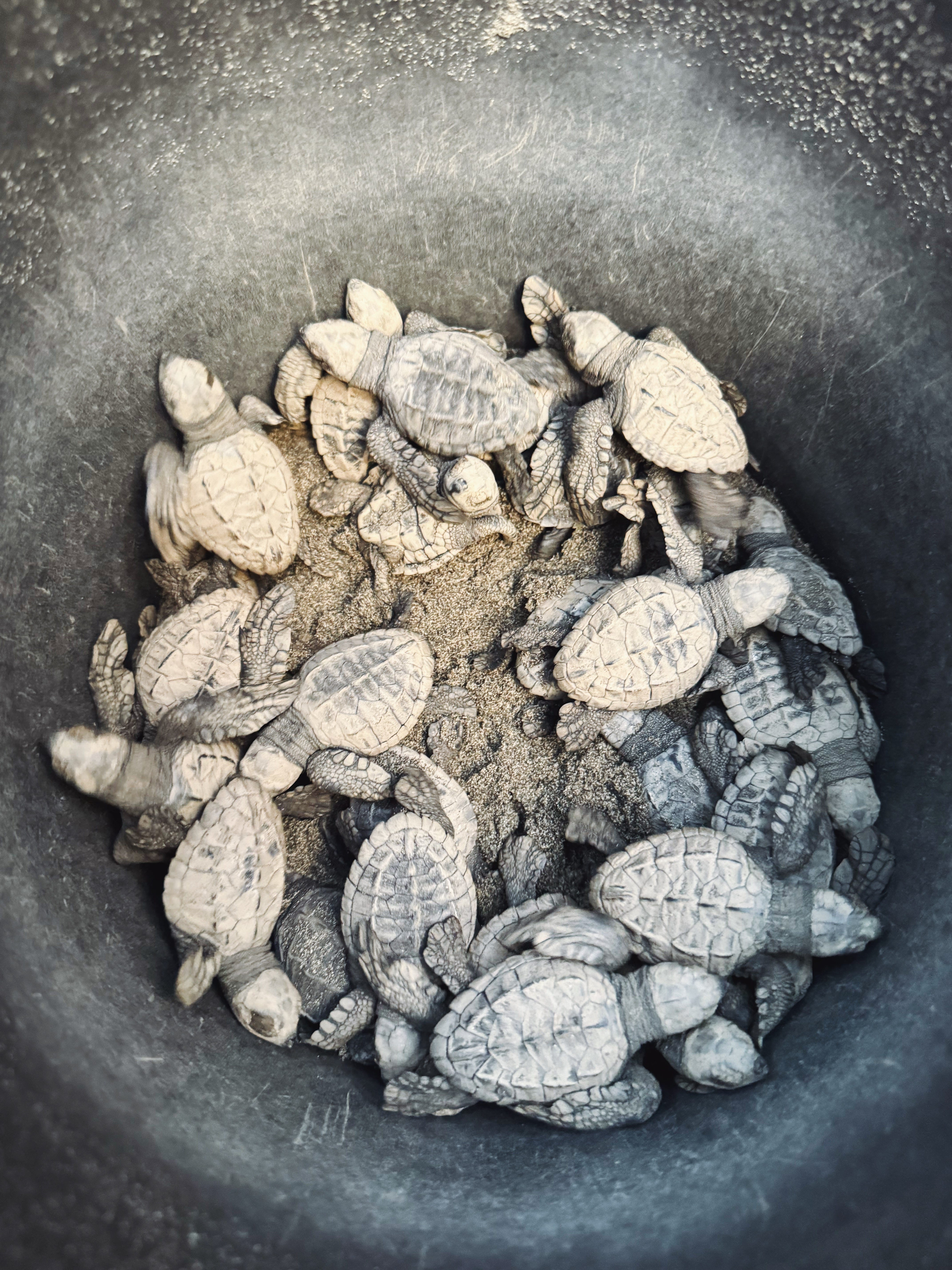
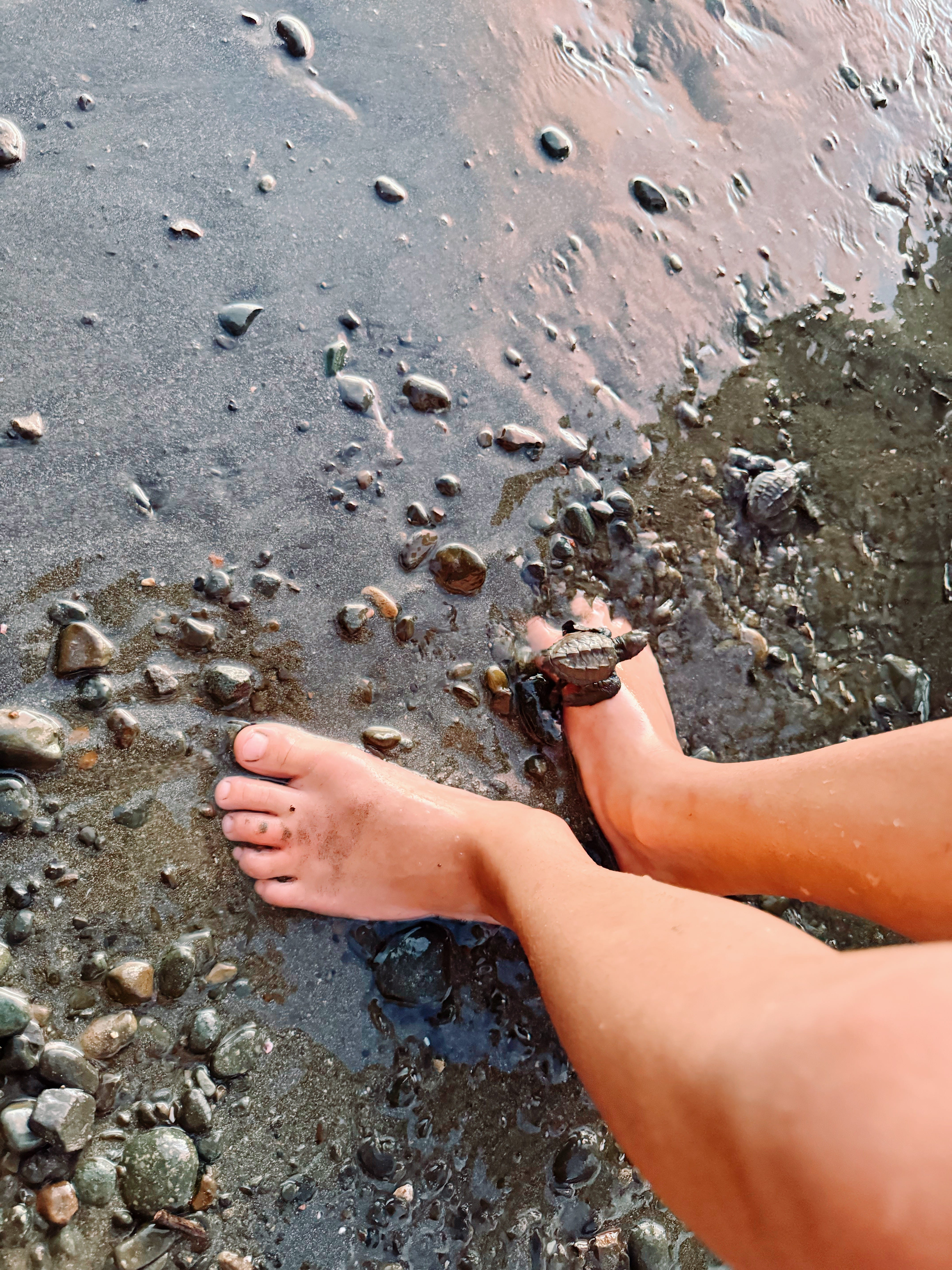
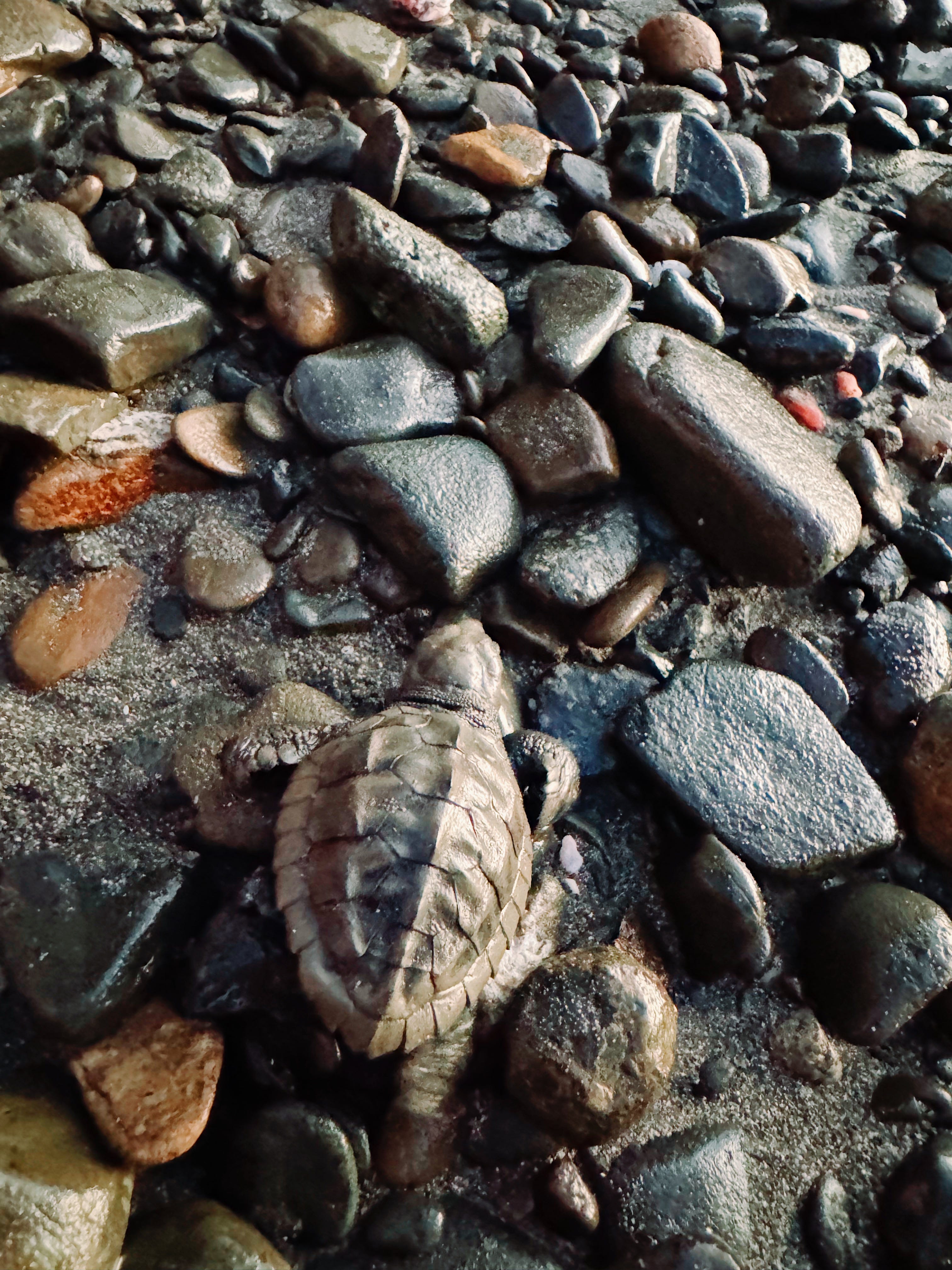
Special thanks to Cici, one of the marine biologists who facilitated it for us. If you’re looking to help olive ridley sea turtles in Costa Rica, Reserva Playa Tortuga needs volunteers to lead night beach patrols to find and protect nests, relocate eggs to a protected hatchery, and collect data on nests. The extra perk is that you will also get to attend many releases! You can also visit or donate to the one-of-a-kind Florida Keys turtle sanctuary, a former brothel turned turtle hospital and rehab center that flies in doctors from the mainland to operate on sea turtles and save their lives. If you’re in West Palm Beach, visit or donate to the Loggerhead Marine Life Center in Palm Beach, which is doing some amazing conservation and turtle rehab work of their own. Reducing ocean plastic pollution, eating responsibly, and supporting laws to protect marine life are other ways we can all help ensure a future for these creatures.
As for how my wild Florida spring break story ended, unfortunately, we never got to see the SUV flying through the air. I cleaned out most of my measly savings from odd jobs and my allowance to pay the helicopter towing bill and chip in on legal bills. There were also legal proceedings with the property owners, and before a potential trial, my friend changed his testimony, confessing that he was not the actual driver and that, in fact, I was. I remember getting a call from him one day, asking me to claim responsibility for driving that day. I said, "Sure, of course I would. And so when his lawyer called me to ask me what happened, I told him the truth. A while later, I got a jubilant call from my friend, saying that they were dropping all charges against us and declaring it a mistrial because they had the wrong defendant. We were not innocent, but we still won the case. I’m not sure my two friends ever think about this episode. But I do, because, in some fundamental ways, it made me the person I am today. I guess that’s what childhood is all about.