There are threatened species that get a lot of attention: elephants, rhinos, and tigers, to name a few. And there are others that get almost no attention. You will not find them in a National Geographic special or a coffee-table book. Species like the White abalone (Haliotis sorenseni), the Devils Hole pupfish (Cyprinodon diabolis), and the Texas blind salamander (Eurycea rathbuni) are found only in limited parts of California/Baja, Nevada, and Texas, respectively. They are so rare and endemic that almost nobody in the world even knows about them. No kids that I know of go to sleep with a Texas blind salamander stuffy.
It makes us wonder how many uncommon, hyperlocal creatures are out there that most of humanity will never even know exist—and how many more we haven’t discovered at all.
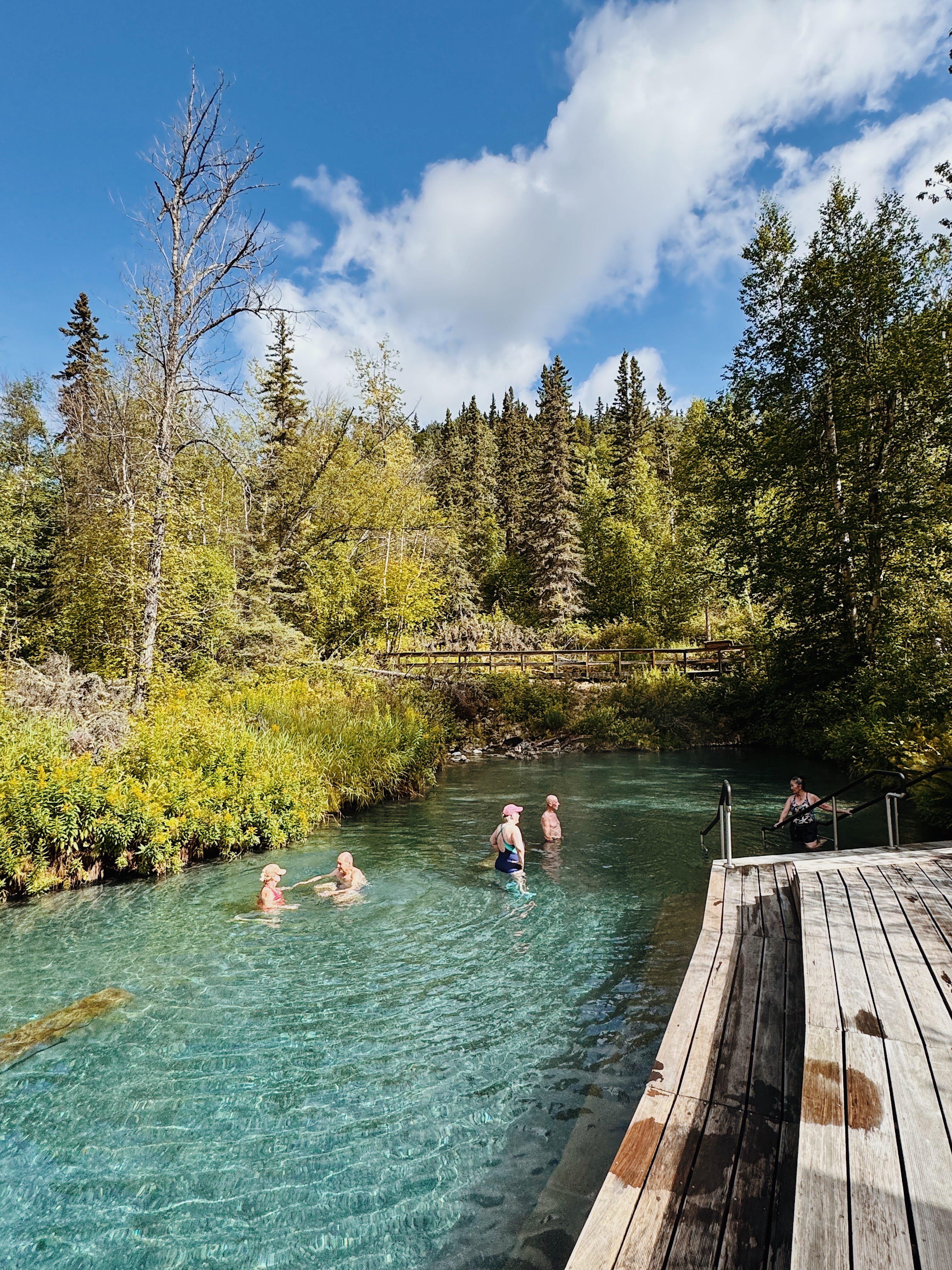
Whenever someone asks us about an unexpected highlight of our trip, we mention Liard Hot Springs. It is this bizarre, somewhat tropical ecosystem in the northernmost reaches of British Columbia. Right on the Alcan Highway, surrounded by hundreds of miles of boreal forest, you find this provincial park on the side of the highway.
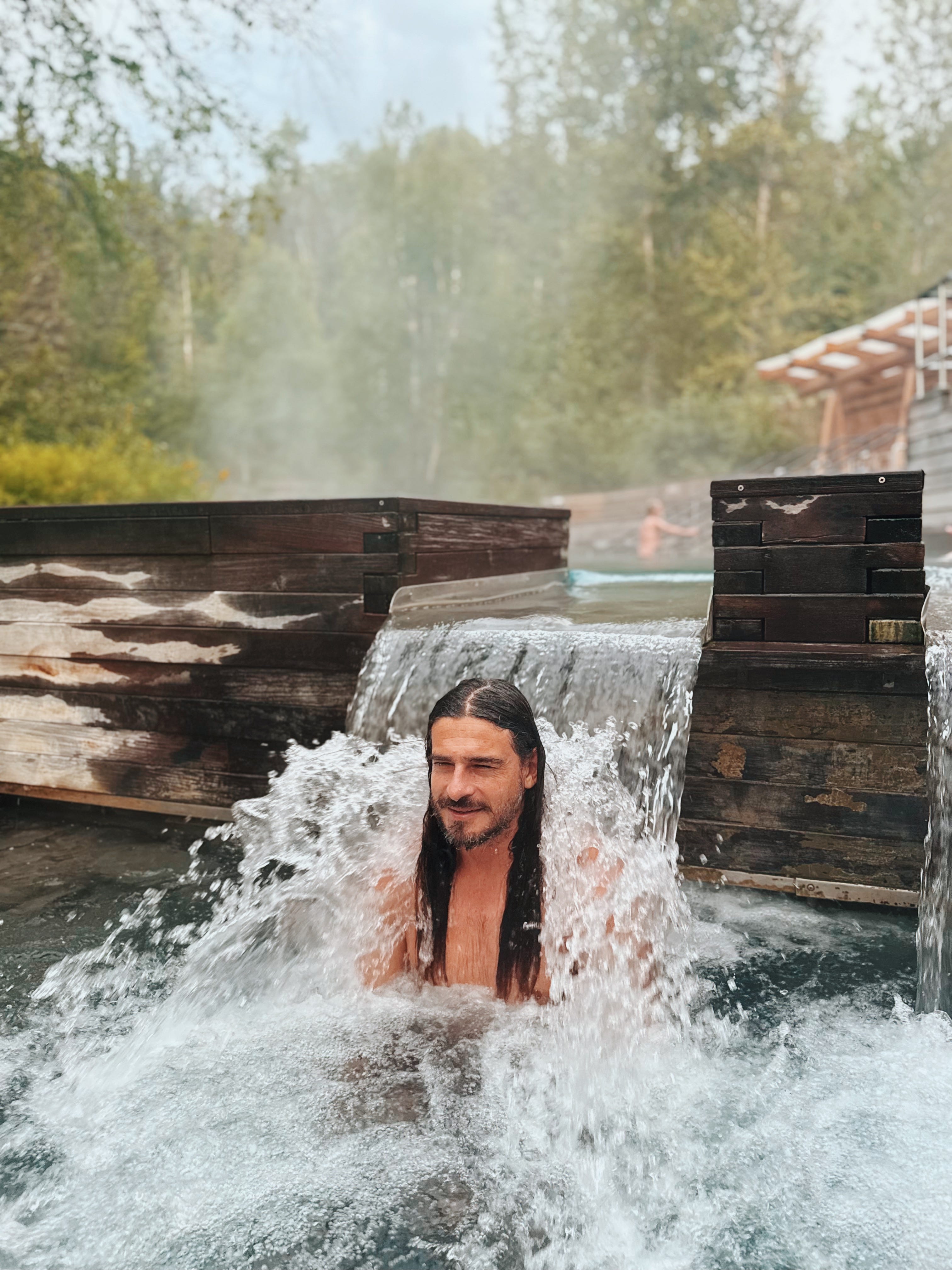
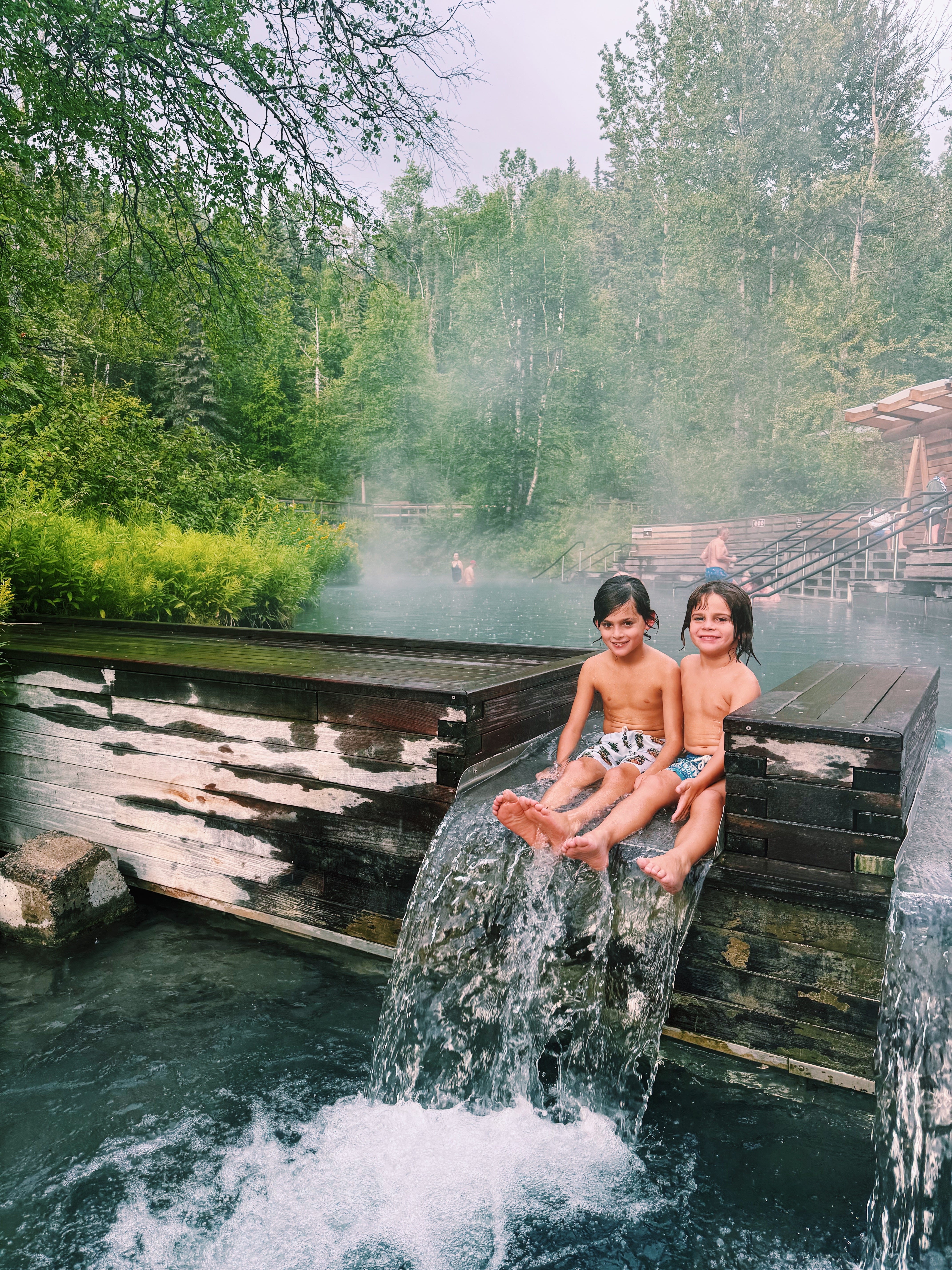
The campsite has electric fencing to protect from bears. You walk through it, leave the protected area, then walk along a kilometer-long boardwalk with bubbling warm water on each side. You eventually arrive at this beautiful, Nordic-looking wooden structure built around an incredibly majestic hot spring.

And it’s precisely because of these thermal waters that you have these incredible species living here that you wouldn’t expect to find for hundreds or even thousands of miles. What species are we talking about?
You got it! Drunk humans.
Just kidding, though there were a few of those, and we understand they are quite widespread globally. No, we’re talking about warm-weather plants like monkeyflower and stinging nettle that occur at Liard far north of where you’d normally expect them, because the geothermal water creates a warm microclimate. There are lake chub (Couesius plumbeus) swimming beneath the boardwalk, remarkable for their ability to survive in the swamp's unusually warm waters. And there is the Plains forktail damselfly (Ischnura damula), a species associated with thermal springs, known from only a couple of locations in all of British Columbia.
And there are, allegedly, according to signs like this one, tiny snails that are literally found nowhere else on Earth. They are called Hotwater Physa.
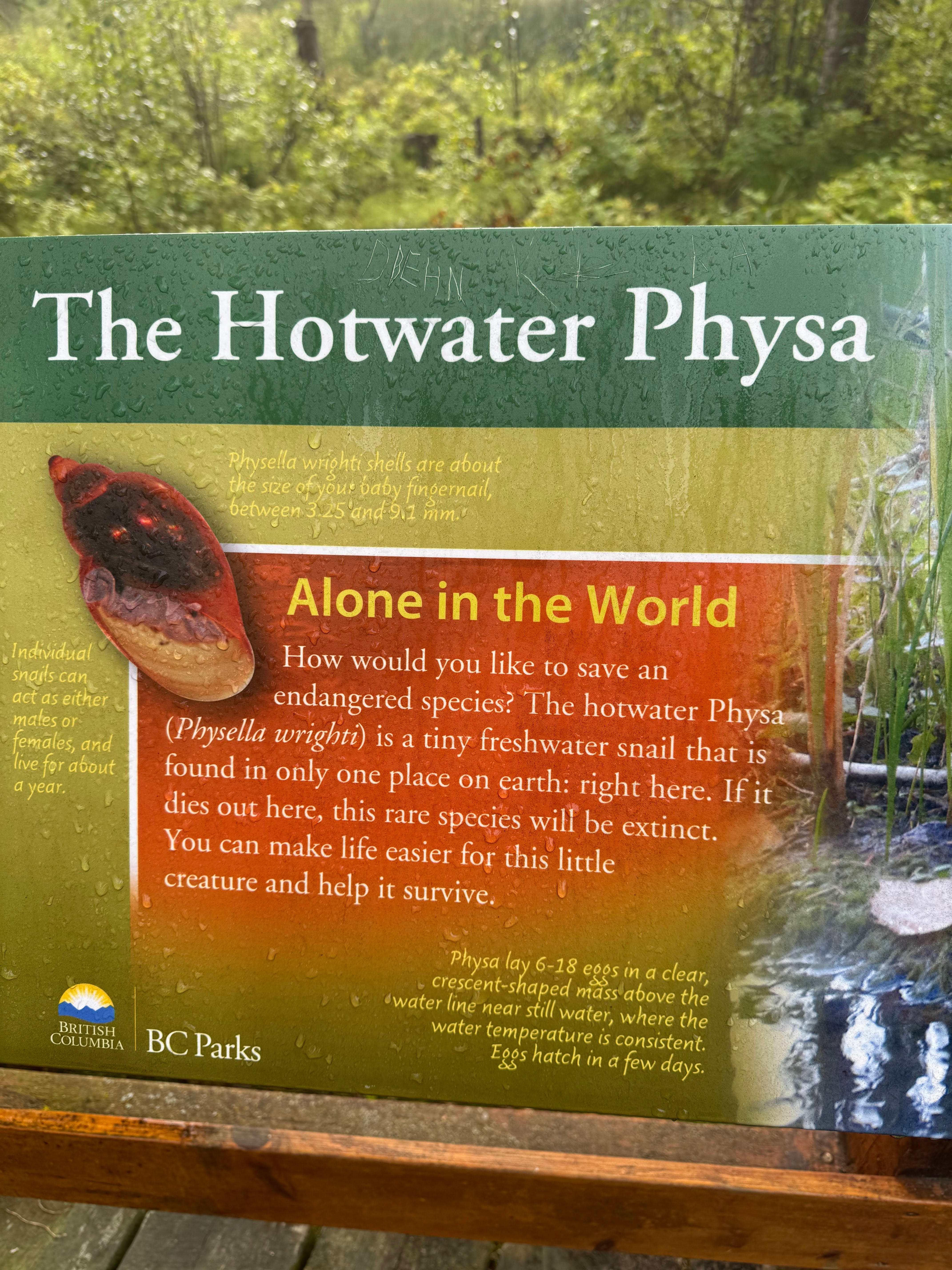
The problem is…we couldn’t find one. We looked under rocks, under trees, in our swimsuits, and no tiny snails!
We asked the ranger for tips on finding them. She said to look under the rocks just above the water line in the less-hot pools. So we adjusted our thinking.
You see, these snails are small. Really small. The kind of small that requires you to recalibrate your eyes. And so we had to focus and get up close to the dirt under the rocks right above the water line. And when we did that, we found these tiny little black speckles. If we paid really close attention, we noticed that they were moving ever so slowly, almost snail-like.
By George, we spotted them! The snail that you can find nowhere else on Earth, except in this one solitary hot-springs complex in the middle of nowhere, tucked away in this remote forest of British Columbia.
And consider this: scientists have estimated the snail’s actual occupied habitat at roughly 4.6 square meters. Not square kilometers. Square meters. An entire species whose known world could fit inside a small bedroom.
They are so easy to overlook that it’s taken us nearly a year to write about them. But friends, we would argue that these snails deserve their place in the sun. In the limelight. Their 15 seconds of fame on this Earth Parade Substack, read by hundreds!
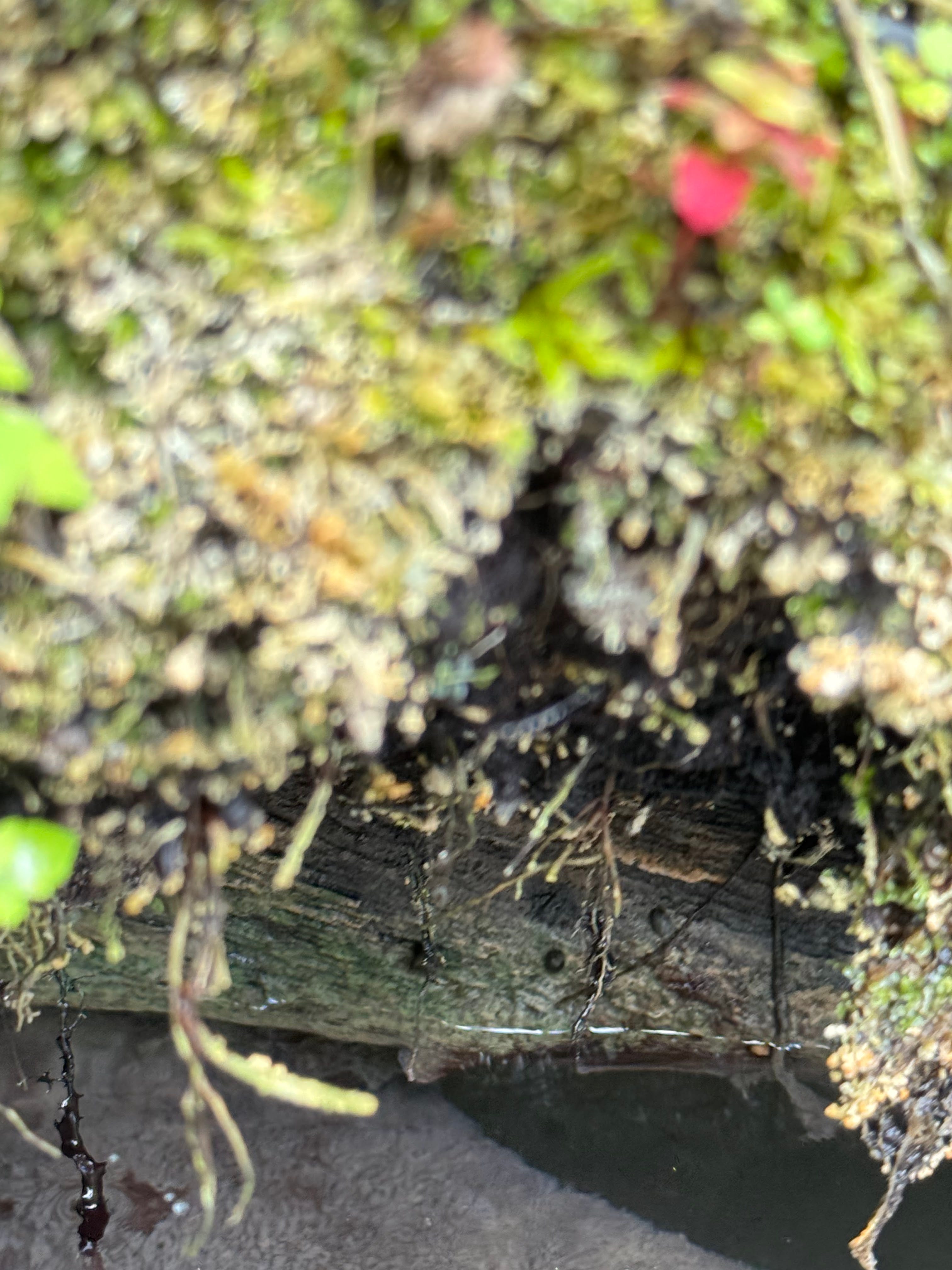
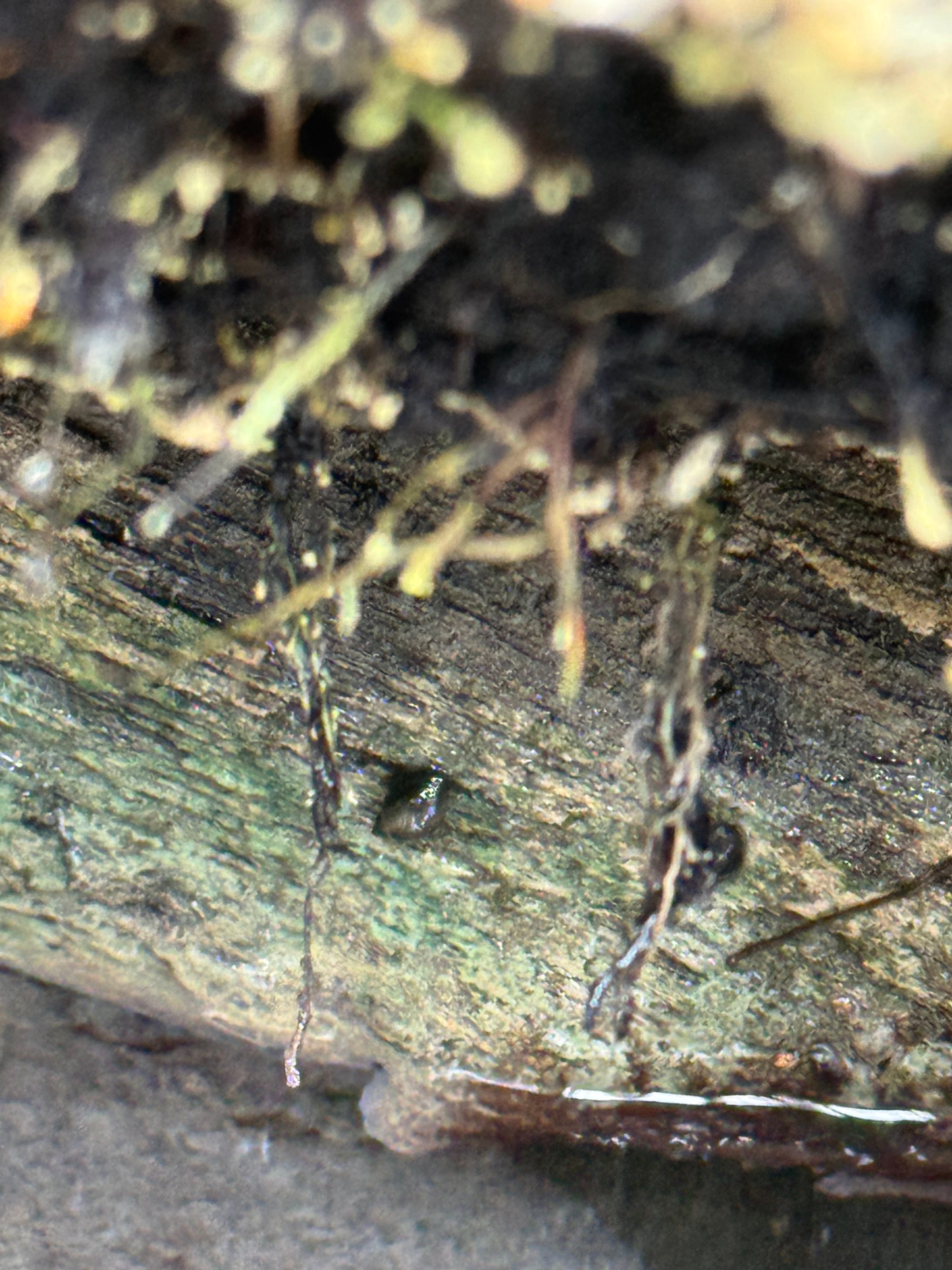
Are they disappearing? As far as scientists can tell, not necessarily. There is no clear evidence of a long-term decline. But that’s not the same thing as being safe. To disappear, you must first appear. And perhaps this is their advantage. Most people go into this spring and have no idea these tiny little snails surround them.
They are just millimeters in size, grazing on the algae and bacteria growing on submerged surfaces. A tiny snail with a thin, translucent shell that coils to the left instead of the right. Scientists believe fewer than 10,000 exist on Earth, all within this single hot-springs complex at Liard.
The snail was first collected here by scientist Dwight Clarke in 1973 and formally described as Physella wrighti in 1985. Scientists even debate exactly how distinct the Hotwater Physa is from its widespread relative, Physella gyrina. For now, Canada recognizes it as its own endangered species—and every known member lives right here.
But have no fear, Physa lovers: Canadians love their nature as much as they love their Zambonis and cold beers. Plus, Liard is protected by the ferocious Canadian government, so we have nothing to worry about, right? Right?
And the question is, how much would it matter if they disappeared? It would be as if a tree falls in the woods and nobody hears it. It makes us wonder how many unknown species have already disappeared as a result of human activity that we humans have never heard of. Perhaps because they were so tiny, we missed them.
And it is for this small but profound reason that we are extra proud to add them to our creature catalog.
It’s also a huge part of why this trip to Liard Hot Springs was so special for us. Anyone who knows us knows we are thermophiles and there isn’t a hot spring we don’t love. But this one is among the most glorious we’ve ever soaked in. And somehow this place is so special it even has its own dedicated little cleaning snail, grazing away on the surfaces of the spring.
It is one of the planet’s most endangered snails, not because its numbers are shrinking, but because its entire fate is tied to one specific place on Earth. If something catastrophic happened to this tiny hot-spring ecosystem, there would be nowhere else for the Hotwater Physa to go.
And what this snail taught us was that:
1. Thinking small is actually thinking big.
Look at the details in nature or in your environment. Paying attention to one blade of grass helps you understand the miraculous state of the world. There is a Jewish teaching inspired by King David’s Psalms that I remember learning in Hebrew school: contemplate something as ordinary as your own hand closely enough, and you begin to understand the greatness of its Creator.
That idea has always stuck with me. Sometimes understanding something enormous begins by paying very close attention to something very small.
2. Take care of your home.
This is what the snail does all day. It takes care of its one and only home in the universe. It eats and takes care of the one place where it exists.
3. Weirdness is worth celebrating.
Just when you think you’re in a boreal forest, surrounded by the same types of trees, there is this strange ecosystem. Why? Who knows? What’s clear is that weirdness is part of our planet’s design. And we should embrace it, celebrate it, and preserve it.
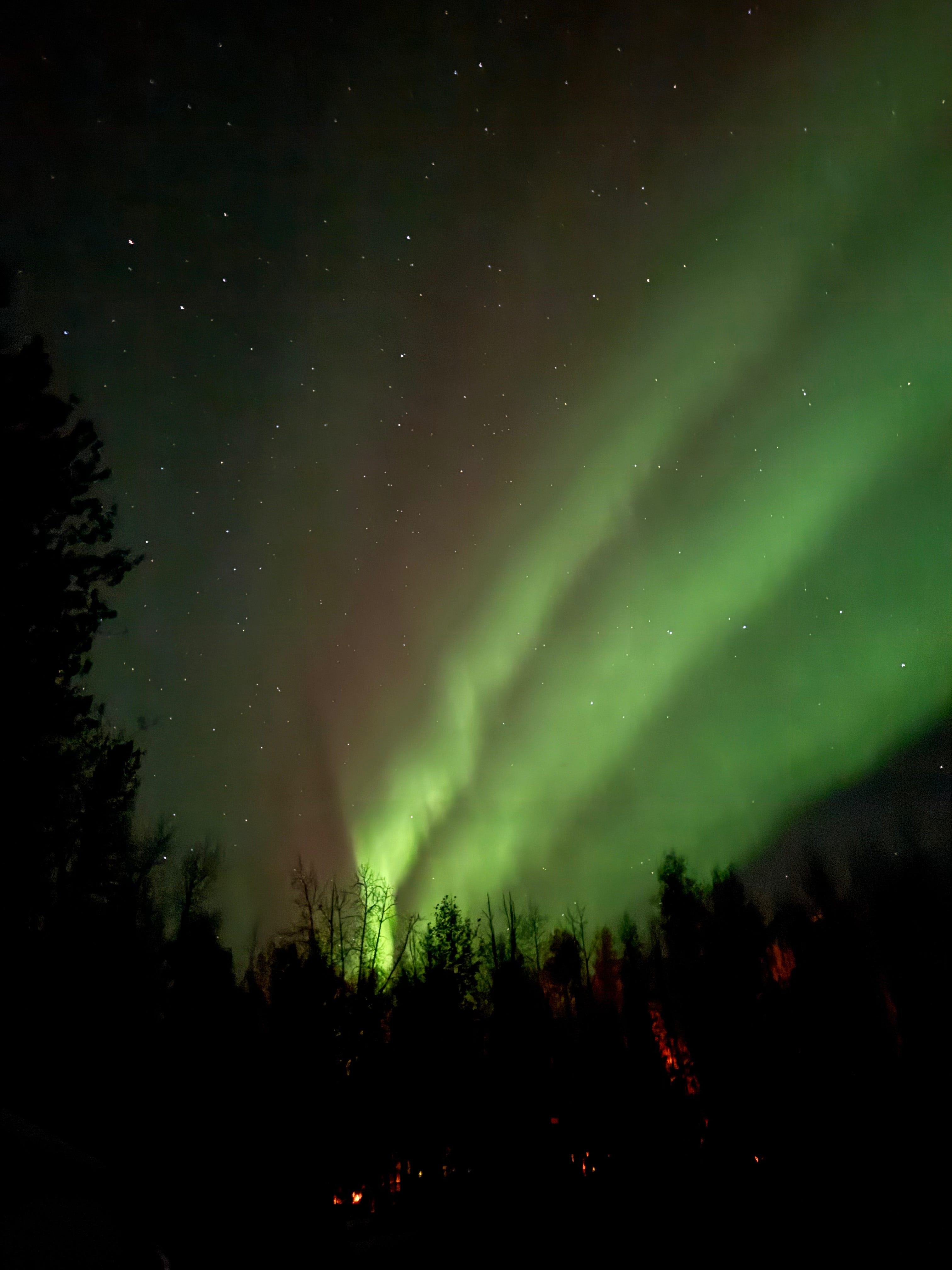
We went to Liard twice: once on the way to Alaska and again on the way back. The first time, in late June, we just enjoyed the eternal light and soaked in the spring with no phones or cameras. The second time, on the way back, summer had ended, the light was different, and we brought our cameras into the spring and got the photos and videos you see above. It was September 17th, 2025. After a night soak in the spring, as we were going to bed that night in our Airstream parked in the overflow parking lot across the highway from the park, we looked up at the sky and saw one of nature’s grandest spectacles: the Northern Lights, for the first time.
We recalibrated our focus again, from the tiny specks moving beneath our noses to the largest possible scale. And all we could do was marvel at the wonders of this planet, celestial and microscopic.
We have never felt more blessed and closer to God.